
Webinar | CDO Blueprint: Partnering with the Business on Trusted Data, AI Use Cases & Data Products Deep dive into the CDO Blueprint, and learn how to build a data trust layer that actually scales.
Leadership Summit – Atlanta – The Westin Atlanta Perimeter North – March 19, 2026 Join top AI and Data leaders in Atlanta to explore the strategies, governance, and innovations driving enterprise performance. Connect, learn, and gain actionable insights — reserve your seat today.
Webinar | Qlik How AI Is Forcing a Redesign of the Data Organization Date: March 26 Industry experts explore the emergence of new human–AI roles—from AI supervisors and agent coordinators to hybrid data leaders who combine domain expertise with AI fluency
Opinion & Analysis
Why the Knowledge Layer Is the Next Frontier for AI-Driven Business Automation

Written by: Vino Kingston | AI Transformation Strategy & Integration Leader, Lockheed Martin
Updated 4:47 PM UTC, March 17, 2026

Organizations today are seeking ways to shift from reactive operations toward proactive, intelligent automation. The foundation of this evolution lies in how businesses manage, interpret, and operationalize their data. The diagram titled “Evolution to Knowledge Layer” illustrates a strategic progression of enterprise data architecture — from basic operations to AI-driven intelligence — framed across four key layers:
- Operational Systems
- Data Layer
- Semantic Layer
- Knowledge Layer
Each tier plays a pivotal role in how businesses execute, manage, and automate their operations, with the Knowledge Layer representing the pinnacle of AI-driven transformation.
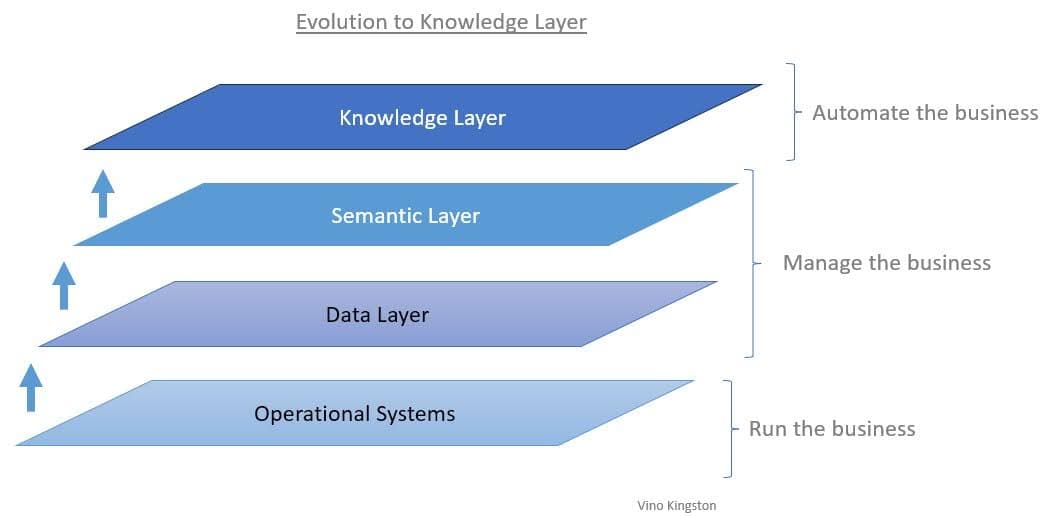
This article explores the evolution of the Knowledge Layer and how it is becoming a game-changer in taking businesses to the world of hyper-automation.
1. Operational Systems: Run the business
At the base of the architecture lie the Operational Systems, where day-to-day business processes are executed. These systems, such as ERP, CRM, supply chain, and HR platforms, generate transactional data that reflects the pulse of the enterprise. While critical for business continuity, the data at this stage is raw, fragmented, and often siloed, limiting its use for strategic insight.
2. Data Layer: Structure and store
The Data Layer captures and consolidates this operational data, enabling storage, querying, and basic reporting. Here, data lakes, warehouses, and streaming platforms transform raw inputs into structured formats. This layer lays the technical groundwork for analytics and insights. However, it still lacks business-ready context and remains challenging for non-technical stakeholders to interpret meaningfully.
3. Semantic Layer: Manage the business
The Semantic Layer adds meaning to the structured data by contextualizing it within the business domain. By introducing business-friendly terminology, data models, and relationships, it allows users to interact with information through a more intuitive lens. This is where dashboards, KPIs, and BI tools come into play, empowering decision-makers to manage the business using trusted, consistent insights.
Yet, despite these advances, a significant challenge remains: human dependence.
Even with robust data and semantic layers, decision-making is still heavily reliant on human interpretation, a costly and time-consuming “human-in-the-loop” process difficult to scale.
4. Knowledge Layer: Automate the business
Enter the Knowledge Layer, the apex of this evolution. Powered by Large Language Models (LLMs) and advanced AI techniques (Knowledge Graphs and Retrieval-augmented generation), this layer acts as a centralized intelligence fabric across the enterprise. It synthesizes structured data and domain knowledge into actionable insights, enabling:
- Predictive capabilities that anticipate trends and outcomes
- Generative AI for content creation, scenario modeling, and innovation
- Agentic AI that empowers autonomous action based on business rules and objectives
By encapsulating organizational intelligence, the Knowledge Layer replaces fragmented decision-making and enables scalable automation, transforming how businesses operate. This is the layer that enables the automation of complex tasks such as fraud detection, hyper-customer personalization, supply chain optimization, and dynamic pricing.
For example:
- A retail business can use the Knowledge Layer to automatically adjust inventory based on forecasted demand.
- A bank can identify and act on anomalies in transaction data in real time.
- A healthcare system can prioritize patient care based on AI-driven risk assessments.
AI’s dependency on the lower layers
It’s critical to note that AI in the Knowledge Layer is only as powerful as the layers beneath it. Poor data quality in the Data Layer or ambiguous logic in the Semantic Layer will cripple AI’s effectiveness. This is why leading organizations are investing in end-to-end Data Governance and robust semantic modeling before attempting to deploy AI at scale.
From insights to autonomy
The journey from Source Systems to the Knowledge Layer is a journey from data collection to insight generation to business automation. While humans currently manage and monitor many processes, the goal of AI is to eventually take over high-volume-low-value tasks and support humans in high-value, strategic decision-making.
Strategic impact
This layered evolution offers a clear path for organizations striving to become intelligent enterprises:
- Run the business efficiently with operational systems
- Manage the business with a trusted semantic foundation
- Automate the business through AI-powered knowledge synthesis
Organizations that successfully adopt and integrate a Knowledge Layer will unlock new levels of agility, responsiveness, and innovation—turning data into a true strategic asset.
Conclusion
The Knowledge Layer represents the intelligent core of a modern AI-powered enterprise. By building upon robust data and semantic foundations, this layer enables organizations to not just understand what is happening but to predict and act on what will happen next. As AI continues to mature, the Knowledge Layer will become increasingly central to automating complex business operations and driving innovation.
In the second article of this series, we will take a deep dive into the Knowledge Layer, exploring how a well-designed architecture enables various business functions across the enterprise to collaborate and make seamless, cross-functional decisions—powered by AI agents.
About the author:
Vino Kingston is a Data, AI, Digital, and Decision Intelligence leader with 30+ years of experience delivering enterprise transformation at Fortune 10 companies. His journey began in Instrumentation & Control Engineering, where he worked with real-time systems and industrial automation — giving early exposure to the Industrial Internet through process control and plant operations. That foundation sparked a passion for workflow automation and data-driven decision-making.
Over the years, Kingston has built and led large-scale data and AI strategies — bringing together data, business processes, applications, AI, and automation to drive measurable business impact. Vino specializes in Enterprise Data & AI Strategy, Decision Intelligence & Automation, Data Integration, Management & Governance. Self-Service Analytics, Data Science, and AI Platforms, Lean/Agile Implementation at Scale.
Kingston has led high-performing teams through major digital and analytics transformations, delivering hundreds of millions in business value by empowering smarter, faster decisions across tactical and strategic scenarios. Curious by nature, Vino always explores what’s next in AI, automation, and digital transformation—and how they intersect to shape smarter businesses.



 Elevate Your Personal Brand