
Webinar | CDO Blueprint: Partnering with the Business on Trusted Data, AI Use Cases & Data Products Deep dive into the CDO Blueprint, and learn how to build a data trust layer that actually scales.
Leadership Summit – Atlanta – The Westin Atlanta Perimeter North – March 19, 2026 Join top AI and Data leaders in Atlanta to explore the strategies, governance, and innovations driving enterprise performance. Connect, learn, and gain actionable insights — reserve your seat today.
Nominations Now Open: Global Data Power Women 2026 Spotlight women leading data and AI at scale.
Opinion & Analysis
Why Enterprise Architecture Drifts and What Leaders Must Watch For

Written by: Moataz Mahmoud | SVP, Enterprise Data Management, First Citizens Bank
Updated 2:00 PM UTC, March 11, 2026

In complex enterprises, architecture does not typically change through sudden disruption. It evolves quietly as teams adjust definitions, refine processes, and interpret requirements in different ways. These micro decisions accumulate and begin shaping the enterprise in ways that may not be visible at first. Understanding how this movement occurs and how to guide it is essential for organizations that depend on stable data, consistent analytics, and scalable digital capabilities.
The quiet shifts that shape enterprise architecture
In every large organization, architecture rarely breaks in dramatic ways. It shifts quietly. Teams make local decisions, requirements evolve, new regulations arrive, and priorities adjust. Products and initiatives often move faster than enterprise alignment can keep up.
Over time, these small adjustments introduce subtle differences in how systems, data, and capabilities operate across the organization. Leaders often sense this before they see it. Delivery becomes slower, integration requires more effort, and strategic initiatives feel heavier than expected. These patterns are not signs of failure, but the natural dynamics of operating at scale. The challenge is maintaining clarity and cohesion while the enterprise continues to evolve.
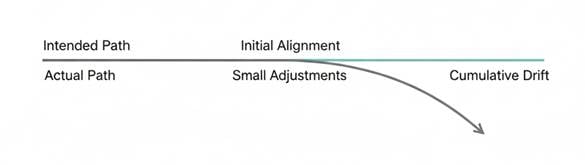
Research from McKinsey explains that these variations rarely cause immediate disruption. Instead, they show up through gradual changes such as slower delivery, higher integration effort, or increased inconsistency in analytics. These patterns indicate an opportunity to strengthen alignment, rather than a need for major redesign.
Where architecture is really tested
Architectural integrity is not defined by the initial design. It is shaped by how the organization responds once a solution enters production. After deployment, teams encounter practical constraints, operational pressures, and shifting priorities that require adjustments. These changes are a normal part of working in a large enterprise and often reveal how a capability behaves under real conditions rather than ideal ones.
As teams refine processes to meet timelines or adapt to new information, interpretations begin to vary. A definition may shift slightly to support downstream reporting. Integration may be adjusted to address a data quality issue. External influences, such as regulatory updates or new business requirements, introduce additional considerations. Each adjustment makes sense locally, but when these changes occur independently, they can gradually move the enterprise away from its intended architectural direction.
Research from MIT Sloan shows that enterprise architecture provides the greatest value when it is treated as a business capability that guides how the organization adapts to change rather than a static set of technical artifacts. This perspective reinforces the importance of understanding how real-world adjustments influence the broader environment and where alignment may need to be reinforced.
Ultimately, the test of architecture is not the blueprint but the organization’s ability to keep solutions aligned as conditions change. Alignment becomes the leading indicator of architectural health because it reflects how well teams can adapt while maintaining consistency across domains. When alignment is maintained, architecture becomes a living capability that evolves without creating unnecessary complexity.
Requirements as strategic signals
Requirements often appear tactical, but in large organizations, they function as leading signals of business intent. They reflect evolving priorities, constraints, risk appetite, value expectations, and the ways different teams interpret the same objective.
When these signals diverge or evolve independently across domains, teams begin moving in different directions while believing they are aligned. Strong requirements discipline is not about maintaining documentation. It is about ensuring the enterprise has a shared understanding of what needs to be achieved and why it matters, even as objectives shift over time.
The continuous alignment loop
Large organizations operate within an ongoing cycle of setting direction, translating that direction into solutions, observing how those solutions behave in real-world conditions, and adjusting course as new information emerges. This cycle continues regardless of whether the organization formally names it or documents it. It reflects how complex environments function, where business needs evolve, constraints change, and teams refine their work to match current priorities.
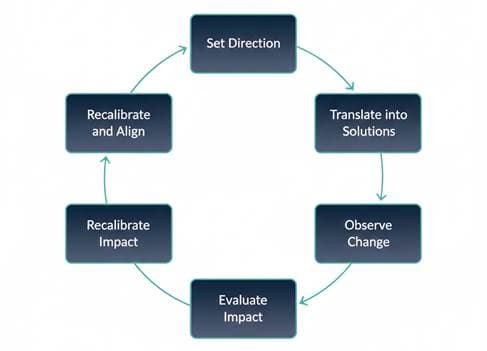
When this alignment loop functions well, the enterprise stays coordinated even when decisions are federated across many teams. Strategic intent remains clear, and solutions evolve in a way that supports the broader organizational trajectory. This coherence allows teams to innovate locally without creating unintended divergence at the system level.
When the loop weakens, each domain begins optimizing around its own needs. Definitions drift, processes evolve independently, and cross-domain integration becomes more difficult. Over time, the organization experiences slower delivery, inconsistent data behavior, and rising operational friction. These symptoms often indicate that alignment is happening late, inconsistently, or not at all.
Effective alignment is framework-agnostic. It relies on the ability to observe where the architecture is shifting, identify what is driving those shifts, and make informed adjustments before small variations compound into broader inconsistencies. Enterprises that maintain this continuous loop strengthen their architectural integrity and are better equipped to respond to changing conditions without introducing unnecessary complexity.
Research from McKinsey highlights that enterprises benefit from lightweight collaboration models, shared architectural priorities, and regular alignment routines that reduce fragmentation as teams adapt to changing conditions.
What executives care about most
Executives focus on outcomes that allow the organization to advance with clarity and stability. They look for initiatives to progress with minimal friction. They expect analytics, reporting, and emerging AI capabilities to behave consistently across business areas, as inconsistent outputs create uncertainty and slow decision-making. They value technology investments that reinforce one another rather than introduce resets with each new project.
Innovation is essential for growth; leaders expect it to be introduced in a way that does not create new challenges for downstream teams. They look for solutions that scale without repeated redesign, processes that remain stable as workloads increase, and data that behaves consistently across business functions. These expectations reflect the broader need for predictable progress, where new capabilities enhance the enterprise rather than introduce additional layers of complexity.
Architectural integrity supports these objectives by enabling the enterprise to evolve as a coordinated system rather than a set of disconnected silos.
Improving alignment without adding complexity
Improving alignment does not require extensive processes or rigid oversight. It relies on a foundation of shared language, consistent decision logic, and clear architectural priorities that guide how teams interpret and refine their work. Simple alignment practices, used at the right moments, help reveal where definitions are drifting, where processes vary, or where integrations need additional attention. These touchpoints are designed to support collaboration by making it easier to understand how local decisions influence the broader system.
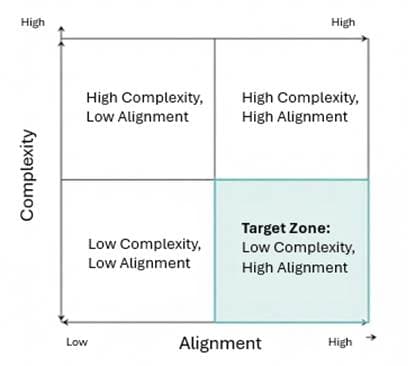
When lightweight mechanisms are used consistently, they allow teams to pivot without introducing unintended complexity. Small clarifications can prevent larger issues later, and early visibility into changes reduces the effort required to reconcile differences across domains. The aim is to create an environment where coordination is natural and unobtrusive. The result is clearer communication, smoother delivery, and an enterprise that can evolve without unnecessary rework.
Architecture as a living capability
Architecture functions as a living capability that adapts as the organization expands and introduces new demands. Its value becomes clear when teams can refine solutions without creating instability, and when the enterprise can integrate new technologies or business opportunities without major redesign. Treating architecture as an evolving capability helps organizations guide change with intention and maintain clarity even as complexity increases. This perspective allows architecture to support innovation as a background, quiet and reliable.
Conclusion
Architectural integrity is not a fixed state. It is a dynamic state maintained through continuous attention to how teams adapt and respond to changing conditions. When alignment practices are simple and consistent, enterprises can evolve without introducing unnecessary complexity. This steady approach supports reliable data, predictable delivery, and the resilience to adapt as new opportunities emerge. Organizations that understand architecture as a living capability are better positioned to sustain long-term stability while continuing to grow.
About the author:
Moataz Mahmoud is a data engineering, analytics, and enterprise architecture leader with nearly two decades of experience in highly regulated financial institutions. His expertise spans modern data platforms, cross-domain analytics, operating model design, and enterprise information architecture, supported by deep domain knowledge across the full data lifecycle.
Mahmoud has led modernization programs, platform consolidation efforts, and agile delivery transformations across multiple enterprise domains. His work has strengthened data quality, improved lineage transparency, and increased the reliability of regulatory and analytical reporting. He focuses on uncovering and reducing cross-domain misalignment, one of the most overlooked causes of downstream risk, and on building scalable architectures that help organizations adopt analytics and AI responsibly.
He holds advanced credentials, including CDMP, CIMP CDS, TOGAF, Snowflake Architect, and leadership certification from Cornell University.



 Elevate Your Personal Brand