
Webinar | Your AI Is Ready. Your Data Access Isn’t. Discover how leading data executives are enabling AI innovation while maintaining strong governance.
CDO Magazine Unveils the Top 25 Chicago Data & AI Leaders 2026 CDO Magazine proudly presents the Top 25 Chicago Data & AI Leaders 2026, recognizing the executives leading high-impact data, analytics, and AI initiatives across some of the world’s most influential...
The Evolving Role of the Data, AI, and Analytics Executive: 2026 Benchmark Survey
Opinion & Analysis
Why AI Strategies Fail: The Missing Data Operating Model

Written by: Gaurav Rastogi | Senior Director - Enterprise Data Analytics & BI Platforms
Updated 10:00 AM EDT, July 16, 2026

For most senior data and AI leaders, the question is no longer whether AI matters. That debate is over. The real challenge is much more practical: How do we scale AI without losing trust in the data that powers it?
In my experience, that is where many AI strategies begin to stall. Organizations have modernized platforms, improved pipeline performance, and expanded analytics access, but the moment AI starts influencing real business decisions, trust becomes fragile. Outputs get double-checked, teams fall back to manual review, and initiatives that looked promising in pilot environments struggle to scale.
That gap matters because the stakes are now measurable. Gartner states that poor data quality costs organizations at least $12.9 million per year on average, and it frames data quality as essential for priority use cases including AI and machine learning initiatives. For data leaders, that means the challenge is not simply to make data available. It is to make data reliable enough to support decisions, automation, and AI with confidence and to do so in ways the business can actually operationalize.
Why this problem lands with data leaders
This issue is often described as a technology or IT problem, but I believe it is fundamentally a data leadership problem.
Chief Data Officers (CDOs) and Chief Data and Analytics Officers (CDAOs) sit at the point where platform design, governance, business accountability, and AI readiness intersect. They are the leaders most directly accountable for questions like:
- Which data domains are reliable enough to support AI-driven decisions?
- Where does trust break first when systems begin to scale?
- Who owns reliability when data serves multiple teams and functions?
- How should governance evolve when AI outputs are increasingly part of operational workflows?
Those questions become visible quickly in practice.
A forecasting system may rely on stale or incomplete signals and generate recommendations that look plausible but disrupt downstream planning. A customer-facing AI capability may combine fragmented records and respond confidently with inconsistent information. A decision model may be technically “working” while still depending on data definitions that vary across business teams.
In each of those cases, the underlying issue is not model sophistication. It is that the organization has not yet operationalized trust.
That is exactly why I developed the Back-of-the-House Data Reliability Operating Model—to make trust operational rather than aspirational.
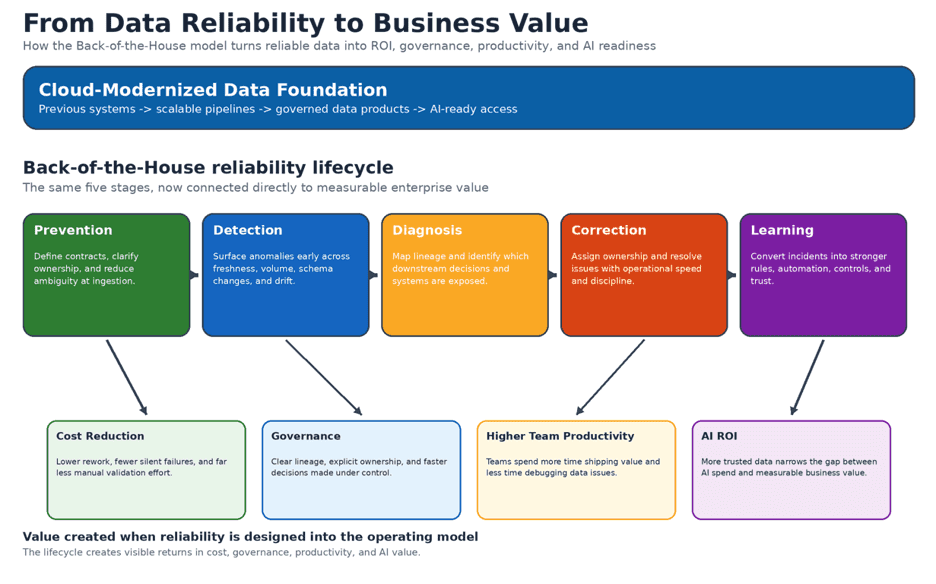
Figure 1: Extending the Back-of-the-House reliability model into business value and AI ROI
I use the term Back-of-the-House deliberately. In industries like hospitality or manufacturing, the most important controls operate behind the scenes, but they determine whether the front-of-the-house experience runs smoothly or fails visibly. I believe data organizations operate the same way. Reliability is not something teams should inspect after an incident occurs. It has to be built into the way the system operates.
The model is structured around five connected stages:
- Prevention: Reduce ambiguity at ingestion through contracts, definitions, and ownership
- Detection: Identify anomalies across freshness, volume, schema, and drift
- Diagnosis: Connect issues to lineage, downstream dependencies, and decision impact
- Correction: Introduce accountable, operationally disciplined response
- Learning: Convert issues into stronger rules, controls, and automation
The value of the framework is not that these stages exist individually; it is that they give data leaders a way to connect reliability work directly to ownership, governance, and decision quality across the organization.
Where trust breaks down in practice
In my experience, trust most often breaks in a few recurring scenarios:
Conflicting definitions across domains
A revenue, fleet, or customer metric appears consistent inside one team’s environment but is interpreted differently by another. AI layered on top of that inconsistency simply scales the confusion.
Technically healthy pipelines, practically wrong outputs
Data arrives “successfully,” but it is late, incomplete, misclassified, or inconsistent enough to create decision risk.
Ownership gaps
Teams can see that something is wrong, but no one clearly owns the issue end-to-end, so correction becomes slow and trust erodes faster.
Governance on paper, not in the workflow
Policies exist, but they do not shape how data changes are detected, diagnosed, escalated, or corrected.
Manual verification overhead
This is one of the clearest signals that trust is weak. If the business still has to repeatedly validate AI or analytics outputs by hand, the value case for automation starts to collapse.
This is also where the framework becomes practical for data leaders. It is not just a way to describe good data hygiene. It is a way to address real business friction.
From data quality to decision quality
One of the most important shifts I have seen is that organizations are no longer optimizing for data quality alone. They are increasingly optimizing for decision quality.
That distinction matters.
Data quality is a necessary condition. But what business leaders ultimately care about is whether the system supports good decisions at speed, under control, and with enough confidence that teams do not have to second-guess every output.
That is where the operating model matters most:
- Prevention improves confidence before data enters the system
- Detection reduces the time issues remain invisible
- Diagnosis helps leaders understand what is actually exposed
- Correction contains operational risk
- Learning strengthens the system over time
In other words, the model is not about reliability as an abstract metric. It is about building the conditions under which data can be trusted enough to support AI and automation.
In practice, that means a CDO or CDAO can use the model to decide where shared definitions need to be standardized, where reliability ownership must be formalized, and which AI use cases are still too fragile to automate confidently.
Architecture matters — but architecture alone is not enough
The architecture view behind the model is still important because it shows that trust does not live in one tool.
It spans:
- the data engineering layer
- the observability layer
- the detection layer
- the decision and action layers
- and, increasingly, the AI intelligence layer that contextualizes signals before they turn into business actions.
But architecture alone does not solve the problem. It enables capability. The operating model determines whether that capability becomes disciplined behavior.
This is one reason the issue is becoming more urgent. IBM reported in June 2026 that two-thirds of surveyed CIOs and CTOs are being held accountable for AI systems they do not fully control, while 77% said AI adoption is already outpacing governance capabilities. IBM also reported that organizations embedding control directly into AI systems experienced 25% fewer incidents than those relying on manual governance
For data leaders, the implication is practical: architecture decisions are no longer only about scalability or performance. They are also about where reliability controls live, how decision risk is surfaced, and how governance becomes executable across shared data domains.
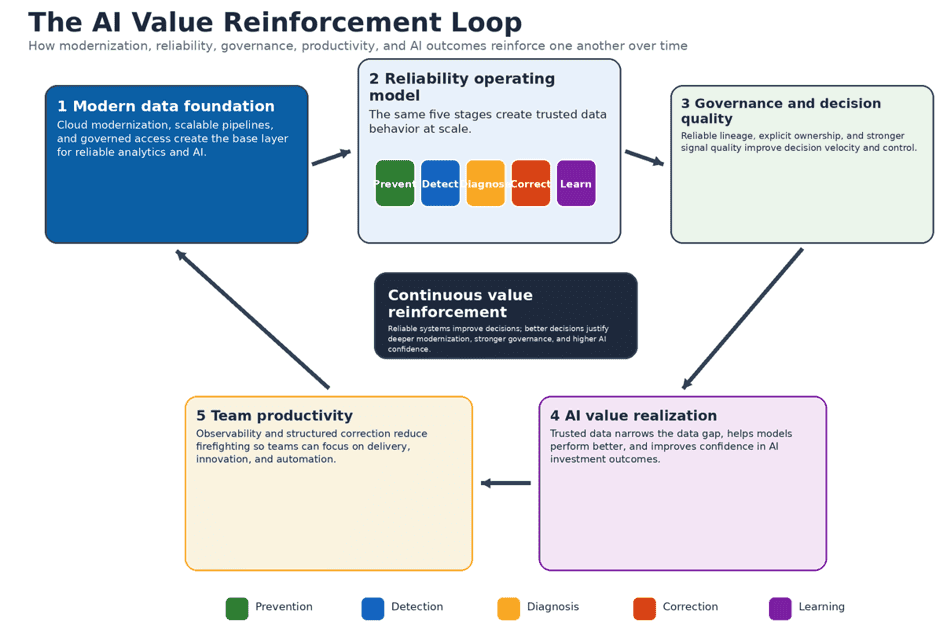
Figure 2 — The AI Value Reinforcement Loop
Closing the loop between modernization, reliability, governance, productivity, and AI value
Figure 2 illustrates an important point: value in this space is not linear. It compounds.
Modernization improves access and scalability. Reliability improves trust in what flows through that environment. Better trust improves governance because ownership, lineage, and decision context become clearer. Stronger governance improves AI outcomes because models are no longer learning from unstable or weakly controlled data. Once AI outcomes improve, leaders become more willing to continue investing in platform, controls, and team capability.
That is not just a pipeline. It is a reinforcement loop.
And it is why I increasingly challenge the idea that modernization alone solves the problem. Cloud and platform modernization are prerequisites. They are not substitutes for a data operating model.
How data leaders can apply the framework
For CDOs and CDAOs, the framework can be applied through five practical actions:
- Map where trust breaks today
Look for the points where decisions slow down, outputs are manually validated, or ownership becomes unclear. - Start with high-consequence decisions
Identify which business decisions are currently too fragile to automate confidently. That is often the best place to begin. - Make ownership explicit across domains
Reliability improves dramatically when prevention, diagnosis, and correction have visible owners. - Connect governance to workflows
Treat governance not as policy documentation, but as something embedded into how data issues are detected, escalated, and corrected. - Use learning as a system capability
Do not stop at incident resolution. Convert recurring issues into rules, automation, and improved controls.
These are not abstract best practices. They are the practical moves that help a data organization shift from reactive trust management to operational trust design.
Conclusion
If there is one lesson I would keep from all of this, it is simple:
You cannot bolt trust onto a system after it breaks. You have to design for it.
AI does not create trust. More tools do not create trust. Systems do.
And for data and AI leaders, the leadership challenge is not simply enabling AI faster. It is making sure the organization has the operating model to trust what AI will do once it scales.
That is why the Back-of-the-House model continues to resonate. It does not ask leaders to treat reliability as overhead. It shows why reliability is one of the most practical ways to convert modernization, governance, and AI investment into measurable business value.
For CDOs and CDAOs, that means the mandate is no longer just to improve data quality; it is to create the operating conditions under which the business can trust AI at scale.
Disclaimer
This article reflects the personal views and professional experiences of the author. The frameworks and concepts described, including the Back-of-the-House Data Reliability Model, are based on original methods developed through enterprise-scale data platform transformation and operational implementation. The perspectives shared here do not represent any specific employer or affiliated organization. References to technologies, platforms, or public benchmarks are included for illustrative purposes only and do not imply endorsement. Business impact may vary depending on organizational context, operating maturity, and implementation discipline.




 Elevate Your Personal Brand