CDO Forum – Dallas – Omni Las Colinas – August 27, 2026 Join top AI and Data leaders in Dallas to explore the strategies, governance, and innovations driving enterprise performance. Connect, learn, and gain actionable insights — reserve your seat today.
CDO Magazine Unveils the Top 25 Chicago Data & AI Leaders 2026 CDO Magazine proudly presents the Top 25 Chicago Data & AI Leaders 2026, recognizing the executives leading high-impact data, analytics, and AI initiatives across some of the world’s most influential...
The Evolving Role of the Data, AI, and Analytics Executive: 2026 Benchmark Survey
Opinion & Analysis
The Role of Automation in Modern Data Governance

Written by: John Tucker | Data & AI Governance Leader
Updated 12:00 PM EDT, July 8, 2026

(This article originally appeared in CDO Magazine’s AI and Data Governance in the Enterprise Trend Report.)
Data governance is entering a new phase driven by automation. With the explosion of data across cloud platforms, SaaS applications, and AI-driven systems, manual controls simply can’t keep up. Plus, the growing regulatory landscape and the rise of AI mean we need to step up our game to build and maintain customer trust.
If governance doesn’t embrace automation, it’s going to have a tough time scaling. But automation isn’t here to replace people or take away accountability. Instead, it enhances stewardship by helping organizations enforce policies more consistently and operate with greater speed and confidence. With the right approach, automation can transform data governance from a periodic review process into a more continuous operational capability.
This article examines how automation is reshaping modern data governance through the lens of supplier data governance within the procure-to-pay (P2P) process. It explores how automated controls can improve data quality, compliance, privacy, and operational efficiency while helping governance scale alongside increasingly complex enterprise workflows.
Why Automation Is No Longer Optional
Traditional governance models were designed for a slower, more centralized data environment. Policies were documented annually, access reviews were conducted quarterly, and data quality checks were implemented only after issues arose. Privacy controls were often reactive rather than proactive.
In contrast, modern data ecosystems operate at a much faster pace. Cloud platforms can scale in minutes, data products are deployed weekly, and AI models are continuously retrained. Regulations evolve more quickly than many governance councils can convene.
Automation bridges this gap by integrating governance directly into data flows, platforms, and decision-making processes. It enables:
- Continuous policy enforcement instead of point‑in‑time audits
- Proactive risk detection instead of reactive remediation
- Real‑time transparency instead of static documentation
Automation allows governance controls to operate continuously within everyday data workflows.
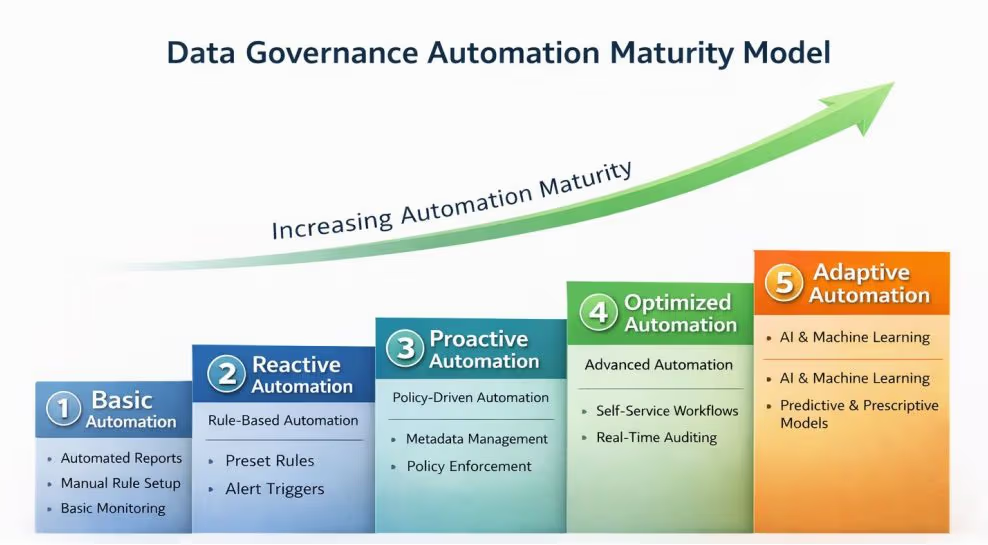
Figure 1. Data Governance Automation Maturity Model
Reimagining Supplier Data Governance Through Automation in the P2P Process
Supplier data is the connective tissue that unites finance, procurement, risk, and operations in today’s procure-to-pay (P2P) ecosystem. When supplier master data is inconsistent, the result is all too familiar: invoice match failures, increased exceptions, payment delays, and unnecessary friction with suppliers. In the sections that follow, I will outline the key pillars of effective supplier data governance and explain how automation can help address these challenges throughout the P2P process.
In the past, many organizations have tackled these challenges after the fact during transformation efforts, leaving AP teams to resolve issues reactively. By contrast, our vision is to embed supplier data governance as an automated, end-to-end capability within the P2P lifecycle, proactively preventing friction before it starts.
We begin by mapping key supplier data touchpoints across the P2P process and identifying areas where automation can deliver immediate value. To operationalize this approach, we initiate a pilot project focused on supplier onboarding. The goal of this pilot is to evaluate how automated controls can improve data accuracy, consistency, and regulatory compliance for newly onboarded suppliers.
By initially focusing on supplier onboarding, we can measure outcomes such as:
- A targeted 40% reduction in manual intervention
- Improved resolution rates for data-related exceptions
- Reduced downstream impact on invoice processing times
Insights from this pilot will help guide how automation expands across later stages of the P2P lifecycle, giving each supplier governance pillar a stronger foundation.
This model stands on five pillars of governance, each elevated by automation to ensure continuous, contextual, and scalable execution.
1. Data Quality: Designed for Prevention, Not Detection
Here, data quality is embedded throughout the supplier lifecycle – from onboarding and ongoing maintenance to day-to-day transactions – rather than measured only after problems surface.
Through automation, data quality becomes a preventive control rather than merely a metric:
- Quality rules are dynamically generated and applied based on how supplier data is used across purchase orders, invoices, and payment processes.
- Anomaly detection continuously evaluates supplier records for match‑risk conditions as data changes occur.
- When issues arise, automated exception reporting and remediation workflows route them to the appropriate business process owners before they surface as invoice exceptions.
The outcome is a more self-correcting quality model that reduces rework, strengthens invoice matching, and instills greater confidence in financial data. This framework helps support our goal of reducing data issues by 40%.
2. Metadata and Lineage: Governance Through Operational Context
Effective supplier data governance requires a clear understanding of how data flows across systems and processes. For instance, when a supplier’s contact or address information changes, accurately tracking its movement from onboarding through invoice processing allows organizations to quickly identify discrepancies that could disrupt payments. Instead of relying on static documentation, metadata and lineage become living, operational assets, allowing real-time analysis of data transformations and supporting prompt operational decision-making.
Through automation:
- Technical metadata is harvested directly from ERP, procurement, and finance platforms.
- End‑to‑end lineage is captured as supplier data moves from onboarding to PO creation to invoice processing.
- Root-cause analysis becomes faster and more precise, grounded in real system behavior rather than guesswork.
Governance decisions are informed by real-time insight into how supplier data is used across governance and ERP platforms.
3. Access and Security: Continuous Control Aligned to Risk
Supplier master data is accessed by many roles across regions, creating additional risk when access is governed primarily through periodic reviews and manual controls.
In this framework, access governance becomes continuous and policy-driven:
- Access to sensitive supplier attributes is provisioned based on role, responsibility, and data criticality.
- Attribute‑based controls help ensure that high‑risk fields such as payment terms or remit‑to details are tightly governed.
- Entitlement drift is continuously monitored as roles and responsibilities change, with managers conducting reviews every 90 days.
- Just‑in‑time access supports operational flexibility without introducing persistent risk.
This approach helps safeguard supplier data without hampering business momentum. These automated controls are designed to integrate directly with our ERP and procurement platforms, minimizing disruption while enhancing governance.
4. Privacy and Protection: Embedded by Design
With supplier data containing both personal and financial information, privacy becomes a non-negotiable governance priority. Rather than relying solely on downstream controls, protection is embedded directly into the data lifecycle.
Automation enables:
- Continuous discovery and classification of sensitive supplier data across platforms
- Dynamic masking based on role, purpose, and context
- Ongoing monitoring for policy violations, reducing compliance risk proactively
Privacy becomes an integral part of the P2P process, not an afterthought.
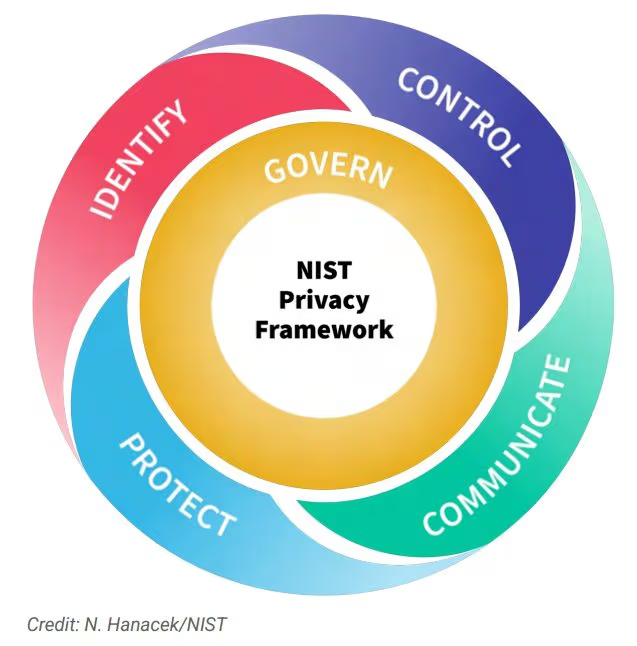
Figure 2. Privacy‑by‑Design Automation Framework
5. Scalable Stewardship and Operating Model
A scalable approach reimagines our data stewardship: stewards become empowered decision-makers, not mere ticket processors, with automation helping route issues more quickly and accurately.
The goal is to automate workflows that route issues promptly and accurately, eliminating manual tracking and allowing stewards to focus on higher-value decisions:
- SLA‑based escalation ensures problems affecting invoice matching are prioritized before month-end or quarter-end processing.
- Approvals are seamlessly integrated into supplier and procurement workflows.
- Stewardship performance becomes measurable, visible, and aligned to business outcomes.
This operating model expands governance reach without adding complexity or overhead.
However, the transition to an automated framework presents a range of change management challenges that must be addressed to ensure successful adoption. These challenges include resistance from stakeholders accustomed to legacy systems, the need for training to build new competencies among process leads, and uncertainty around evolving roles and responsibilities.
In addition, integrating automation requires ongoing process reviews to identify operational bottlenecks, along with clear documentation to support continuity and compliance across new workflows. By proactively engaging stakeholders, implementing structured training programs, facilitating open communication about process transformations, and regularly reviewing and updating procedures, organizations can better address these challenges. This approach helps teams adapt to new automated governance workflows while supporting long-term adoption across the organization.
The Impact: Gains at an Organizational Level
When automation is implemented across various governance pillars, organizations consistently achieve four key outcomes:
- Continuous compliance – Controls run continuously, not just during audits
- Reduced risk exposure – Issues are detected earlier, when they are cheaper to fix
- Faster data enablement – Governance becomes a launch pad, not a bottleneck
- Higher trust – Data consumers gain confidence through visible, automated assurances
Governance shifts from a reactive compliance exercise into a scalable business capability.
The Challenges Automation Introduces
Automation is incredibly powerful, but it requires effort to implement successfully. Organizations often encounter three common challenges when adopting automation:
- Over‑automating without intent: Automating unclear or broken processes only increases dysfunction. Automation should happen after establishing clear policies, ownership, and decision rights.
- Tool proliferation and fragmentation: Point solutions can create isolated controls that fail to contribute to a coherent governance framework. Without proper integration, automation can increase complexity rather than reduce it.
- Trust and adoption gaps: If stakeholders lack trust in automated outcomes or do not understand the decision-making process, they may bypass or resist automation.
How We Can Overcome These Challenges
High-performing governance programs approach automation with a disciplined strategy and focus on outcomes rather than tools. This means they clearly define what “good” looks like in terms of quality, privacy, and access, and then work towards achieving those outcomes through automation.
Additionally, prioritize interoperability in your design. Automation is most effective when metadata, quality, privacy, and access controls can communicate signals across different platforms.
Investing in change management is equally critical. Transparency, explainability, and education help organizations build trust in automated governance decisions.
Finally, embrace iteration. Automation evolves in phases, continuously improving as data products and regulatory expectations mature.
The Future: Governance That Runs at the Speed of Data
As AI becomes more integrated into everyday decision-making, AI governance will become an increasingly important component of enterprise governance programs. Automation will shift from simple rule-based enforcement to more adaptive governance that can anticipate risks, adapt controls, and provide real-time guidance to users.
Organizations that thrive will not view automation as merely a shortcut to governance. Instead, they will recognize automation as an essential component of the governance framework itself. In my vision for the future, governance becomes embedded directly into the data workflows themselves.
References
- DAMA International, DAMA‑DMBOK: Data Management Body of Knowledge, 2nd ed. (Technics Publications, 2017).
- National Institute of Standards and Technology, NIST Privacy Framework (U.S. Department of Commerce, 2020).
- ISO/IEC 27001 and ISO/IEC 27701, Information Security and Privacy Management Standards (2018–2019).
- MIT Sloan Management Review, Governing Data and Analytics for Digital Transformation (2020).
- European Union, General Data Protection Regulation (EU 2016/679).



 Elevate Your Personal Brand