
Webinar | Out of the Shadows: A Step-by-Step Approach to AI Governance Discover how to move beyond the restrictive "block or allow" debate and turn unauthorized AI adoption into a strategic catalyst for transformation.
Nominate Now | Top 30 Healthcare Innovators 2026 List Honoring the Executives Driving Measurable Transformation and Responsible Innovation Across the Healthcare Ecosystem.
CDO Magazine Unveils the 40 Most Influential Data Leaders in Finance — North America 2026 Few industries are advancing data and AI as rapidly as financial services. From real-time payments and fraud detection to risk modeling, regulatory compliance, and AI-driven customer experiences, fina...
Opinion & Analysis
The Emergence of Software 3.0: Transforming Industries with GenAI and Foundation Models


Written by: Partha Anbil | SVP, Life Sciences at Coforge Limited, Deepak Mittal | Founder & CEO, NextGen Invent Corporation
Updated 2:05 PM UTC, March 26, 2026

In recent years, the advent of large-scale foundational models and generative AI (GenAI) has provoked a seismic shift across multiple industries.
Understanding the shift: From Software 1.0 to 3.0
- Software 1.0: Traditional programming requires explicit, line-by-line instructions.
- Software 2.0: Data-driven neural networks, where solutions emerge from optimized learning upon labelled datasets.
- Software 3.0: The current paradigm, in which vast pretrained foundation models, such as LLMs and multimodal generators, are orchestrated through natural language prompts, enabling human-like reasoning, creativity, and adaptability for programming, analysis, and design tasks.
Key features of Software 3.0
- Democratization: Even non-programmers can create complex systems by describing goals in plain language.
- Orchestration: Foundation models work in tandem — text/image, code, speech — composing higher-order AI applications.
- Human-AI collaboration: Rather than full automation, optimal results come from hybrid workflows, with AI automating routine or complex analysis, and humans providing judgment and creativity.
However, Software 3.0 is not devoid of issues such as emergent properties.
What are emergent properties in modern AI?
Emergent properties are skills, behaviors, and reasoning abilities that are not intentionally programmed into large AI models but emerge only when these models are trained to a significant size and complexity on massive, diverse datasets. Rather than being incremental, these abilities often emerge suddenly at a critical scale, which is called a “phase transition,” and are now transforming business, science, and creative industries.
2025 Industry-relevant real-world examples
1. Advanced multimodal interaction
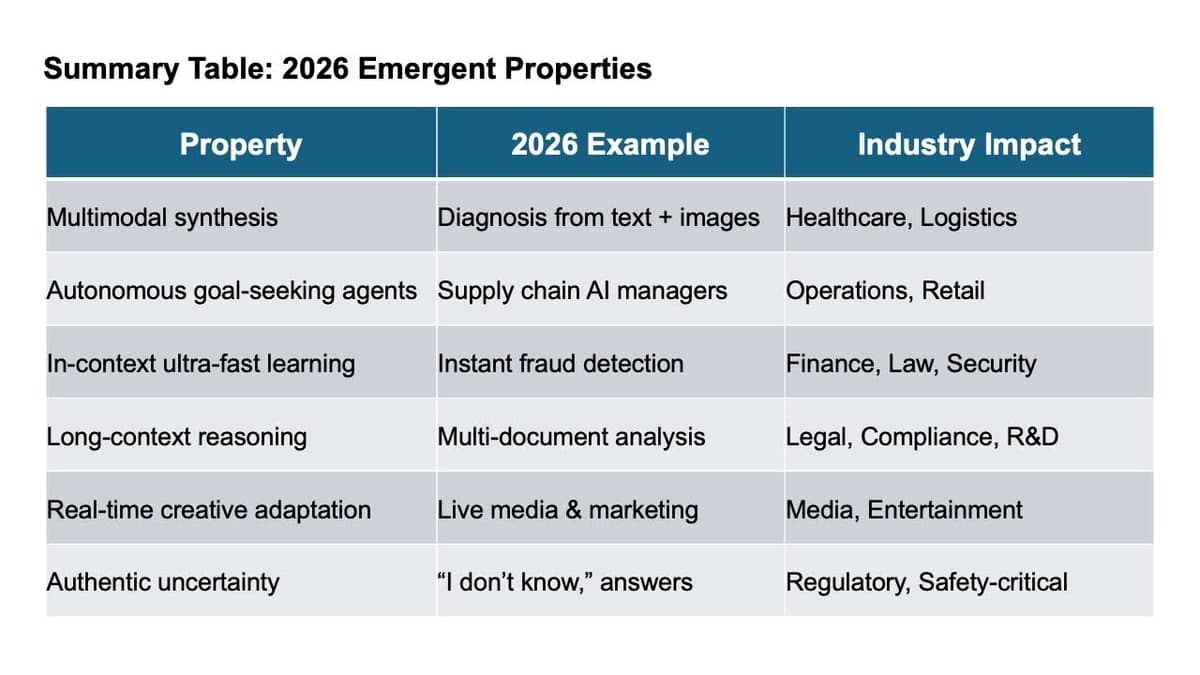
- Example: GPT-4o and Gemini 2.5 models seamlessly process text, images, audio, and video in a single session. In medicine, radiologists can submit a CT scan, clinical notes, and verbal patient intake simultaneously, and the AI synthesizes a diagnostic report, cross-references medical literature, and even suggests differential diagnoses.
- Emergent property: Cross-modal reasoning and decision-making, previously unheard of, now being piloted in enterprise healthcare and autonomous robotics.
2. Autonomous agents (Agentic AI)
- Example: With GPT-5, companies now deploy “AI agents” that execute complex workflows autonomously. For example, a supply-chain AI can negotiate with partners, monitor delivery status, parse invoices, and reorder stocks, sometimes handling entire inventory chains without human oversight.
- Emergent property: Self-directed planning, tool use, and “goal-seeking” behavior. These agents solve problems, delegate tasks to other agents, and escalate only when truly necessary, leap beyond old, scripted bots.
3. In-context generalization and ultra-efficient adaptation
- Example: Feature foundation models in 2025 offered “in-context learning.” Present a few examples of a new fraud type to a bank’s custom AI, and it can instantly detect similar frauds in millions of data records — without explicit retraining.
- Emergent property: Few-shot and zero-shot learning. This enables banks, hospitals, and law firms to rapidly adapt AI systems to new threats, regulations, or cases.
4. Human-like reasoning and long-context analysis
- Example: Gemini 2.5 Pro can read, analyze, and retain complex legal documents of hundreds of pages — summarizing, extracting risks, and providing actionable advice in minutes, with context windows up to 1 million tokens.
- Emergent property: Long-term context retention, insight extraction, and continuous narrative understanding across multimodal content — used in legal, financial, and consulting industries.
5. Creative co-design and real-time workflow automation
- Example: Newsrooms, ad agencies, and game studios are now using AI as co-creators — generating images, audio stings, draft articles, and video clips for live events, then instantly revising based on audience feedback in real time.
- Emergent property: Real-time live generation, adaptive style morphing, and collaborative feedback loops — ushering in a new phase of dynamic media production.
6. Authentic uncertainty and error handling
- Example: GPT-5 and top 2025 models now admit what they don’t know or flag ambiguous cases—crucial for compliance, medicine, and law.
- Emergent property: Conservative reasoning and self-awareness of knowledge gaps. This adaptive skepticism is vital for regulatory and safety-critical applications.
Why do these matter to the industry now?
- Rapid deployment: Teams can repurpose the same model for multiple tasks (compliance checks, fraud, diagnostics, R&D) with minimal retraining.
- Reduced labor costs: Autonomous agents and in-context adaptation automate processes once requiring large teams.
- Creativity & collaboration: AI is now a partner in scientific discovery — hypothesizing new molecules, simulating materials, or co-authoring research papers with experts.
- Safety & compliance: New emergent error handling and uncertainty measures make AI viable for sensitive industries, lowering risk and regulatory hurdles.
Conclusion
The emergent properties now seen in foundation models are revolutionizing professional life in 2025. These capabilities, absent in prior generations, enable real-world, multi-modal, autonomous, adaptive, and trustworthy AI systems in the most advanced industries. Where AI previously added value through automation, today’s emergent systems are co-workers, autonomous agents, and creative partners at scale, with speed and safety not seen even two years ago.
*Disclaimer: The views expressed in the article are those of the authors and not of the organizations they represent.
Partha Anbil is at the intersection of the Life Sciences industry and Management Consulting. He is currently SVP, Life Sciences, at Coforge Limited, a $1.7B multinational digital solutions and technology consulting services company. He held senior leadership roles at WNS, IBM, Booz & Company, Symphony, IQVIA, KPMG Consulting, and PWC. Mr. Anbil has consulted with and counseled Health and Life Sciences clients on structuring solutions to address strategic, operational, and organizational challenges. He was a member of the IBM Industry Academy, a very selective group of professionals inducted into the academy by invitation only, the highest honor at IBM. He is a healthcare expert member of the World Economic Forum (WEF). He is also a Life Sciences industry advisor at MIT, his alma mater.
Deepak Mittal, MBA, M.S., chairs the Supply Chain Committee of CBSACNY and is a contributing author to industry thought leadership. He is an accomplished serial entrepreneur with a proven product, AI, and data Strategy track record. He is experienced in transforming an organization into an insight-driven, AI-enabled organization. Currently, Deepak holds the Founder and CEO position of NextGen Invent Corporation. During his career, Deepak has served as a member of the Board of Directors of many companies, including the Columbia Business School Alum Club of NY, CMR Institute, D4DT, Optym, and Launch Right Now. He is a strategic advisor for various organizations that grew from small start-ups to unicorns and had successful exits. He can be reached at deepak.mittal@nextgeninvent.com



 Elevate Your Personal Brand