
CDO Forum – Dallas – Omni Las Colinas – August 27, 2026 Join top AI and Data leaders in Dallas to explore the strategies, governance, and innovations driving enterprise performance. Connect, learn, and gain actionable insights — reserve your seat today.
CDO Magazine Unveils the Top 25 Chicago Data & AI Leaders 2026 CDO Magazine proudly presents the Top 25 Chicago Data & AI Leaders 2026, recognizing the executives leading high-impact data, analytics, and AI initiatives across some of the world’s most influential...
The Evolving Role of the Data, AI, and Analytics Executive: 2026 Benchmark Survey
Opinion & Analysis
The Customer-Supplier Model: How to Connect Data Literacy to the Way People Work
Data literacy is divorced from the real job of people


Written by: Sandro Saitta | Data & AI advisor at viadata, Thomas C. Redman | President, Data Quality Solutions
Updated 7:00 AM EDT, July 7, 2026

Sandro Saitta and Tom Redman
Data continues to grow in importance across companies and government agencies. This was already true even before the rise of AI. Generative AI has magnified the promise, the perils, and the urgency, placing renewed attention on data literacy across the enterprise.
Chief Data Officers (CDOs) and other leaders are held accountable for turning data into value, but that outcome depends less on technology than on employees understanding and performing their roles in an unsettled data ecosystem.
While data presents enormous potential, unlocking it remains difficult. This is because data is often fragmented, poorly governed and managed, and difficult to use. Which, in turn, creates cost, delay, and uncertainty.
Most attribute this gap to technical shortcomings, legacy systems, or underinvestment in technological infrastructure. Those factors matter, but they are not the whole story.
A more fundamental issue is hiding in plain sight: Everyone touches data, yet most employees don’t realize they have a role to play and what it requires of them.
For example, a marketing analyst preparing a dashboard, a loan officer entering customer information, or an operations manager interpreting a performance metric, all act within a data ecosystem. However, few realize the impact of their work on others. Further complicating matters, every employee has specific needs.
In practice, virtually everyone plays two often overlooked roles: data customers who use data created by others, and data creators who produce data needed by others. But few know they serve in these roles, what responsibilities these roles entail, or how to do the work.
The obvious answer is training, and many organizations have launched data literacy programs. While well-intentioned, these programs miss the mark. Too often they focus on teaching non-data professionals things data experts know, rather than what they need to perform their jobs better.
Employees may learn about sampling and correlation, not what it means to be a good data creator in the context of their jobs as marketing analyst, loan officer, and operations manager.
Based on work with dozens of companies, too many data literacy programs are divorced from real work. The consequences, to companies that struggle to realize the value of their data, to people not contributing at their full potential, and to CDOs whose programs lack power, are very real.
It is time to connect data literacy to the work people actually do. This article proposes that literacy start with employees in their roles as data creators and data customers. It re-introduces the “customer-supplier model,” perhaps the most important tool in data management and in the top few of management quite generally. It also illustrates a pattern for crafting data literacy programs.
Unlike skills-based approaches, which train employees on what data professionals know, the customer-supplier model meets every employee where they are, in the middle of a workflow, receiving inputs and producing outputs.
It is time to rethink data literacy
Employees have not been shown how to perform the data work embedded in their roles. Data literacy is not wholly to blame, because the senior management (including CDOs) has neither clarified nor communicated these roles.
We find that almost everyone wants to contribute but are held back because they lack clarity about their roles.
When data literacy efforts focus only on tools, technology, or analytics techniques, they miss the point: data literacy must be grounded in the work.
A practical starting point is deceptively simple:
- Who are your customers and what do they need from you to do their jobs effectively?
- Who are your suppliers and what do you need from them to do your job effectively?
If one looks, it is easy to see that every employee is both a data customer and a data creator. A frontline employee entering data into a system supplies data to many people downstream. Similarly, a manager using a report is a customer of upstream processes.
However, in practice, people remain isolated in their siloes, unaware of their data customers. It is impossible for them to know whether the data they provide meets these people’s needs.
Similarly, when they do not know the sources of the data they use, they are more easily victimized by errors and hidden assumptions.
For example, consider a barista at your favorite coffee shop. Baristas need to know how to combine ingredients to satisfy specific customer needs. And they may well have to keep up-to-date on new blends and what pastries pair well with arabica beans to engage their customers.
Their training is specific to the work they perform. Yet they do not attend “coffee literacy programs” explaining the underlying theory, why beans are baked at particular temperatures, why beans from different parts of the world taste differently, and so forth.
Interestingly, baristas also create and use data: if an order taker mistakenly fails to enter “decaf,” the customer may receive a jolt of caffeine they do not desire. If a barista observes, but fails to report, “we’re very low on napkins,” a small, albeit minor customer need may go unmet.
Baristas need to understand not only how to make a cup of coffee, but how they fit into the overall “coffee ecosystem,” which involves data.
At scale, the stakes are higher.
For example, a sales representative enters a prospect’s details into a CRM system. If the field is left blank or miscoded, marketing segmentation skews, pipeline reports mislead, and an AI-driven lead-scoring model trains on corrupted inputs. All downstream consequences because of one upstream error.
Similarly, a hospital administrator incorrectly records patient discharge codes: a formatting inconsistency that seems minor in isolation can distort readmission metrics, misallocate resources, and ultimately affect care across the hospital.
Data plays similar roles in every job, at every level, in every company and government agency.
What should a data literacy program include?
If traditional literacy programs have fallen short, what should replace them?
First, the content must be grounded in the customer-supplier model (see below image), because it helps people clarify their roles, where they fit, and what they must do. The customer-supplier model is one of the most important graphics in all of data management (and all of management for that matter).
Everyone who touches data in any way, shape, or form, should be aware of this model. It is the first thing to be taught in any data literacy program.
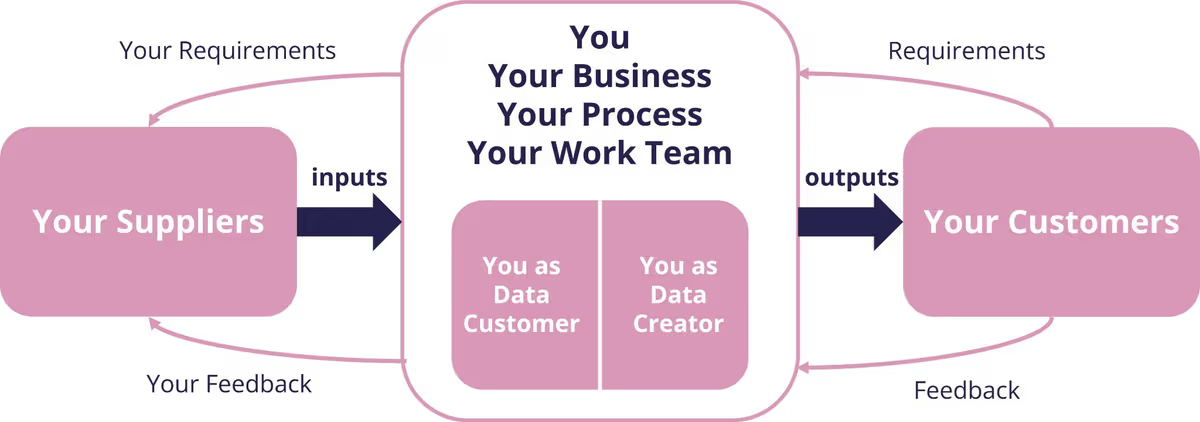
Figure 1: The Customer-Supplier Model
In the figure, you (or your process, team, department) are in the middle, to your left are your data suppliers and to the right your customers. Data flows left to right: You take data needed to do your work from suppliers, complete your work, and pass data on to your customers so they can complete theirs.
This flow is the foundation of the entire data lifecycle. Every entry, either strengthens or weakens data quality in downstream operations, reporting, analytics, and AI. It is impossible to know what happens when a barista logs a customer’s drink preference as “medium” instead of “large.”
The error may skew demand forecasts, distort orders for new inventory orders, and leave the analytics team optimizing for a reality that never existed. These impacts are larger if the error costs the coffee shop a customer. It is good management that the barista understands all this.
Also note that the requirements and feedback channels point in the opposite direction, right to left. One set reflects you informing suppliers of your needs and advising them on how well those needs are met; the other set comes from your customers. Unless these channels are in place, you cannot expect that your needs nor those of your customers are met.
These channels encourage “outside-in” thinking, e.g., “what do others need of me,” which stands in contrast to the more typical “inside-out”, e.g. “how do I do my work” thinking.
With this model in place, the responsibilities of data creators and data suppliers are straightforward and data literacy should teach people to ask:
- Who are my data customers? Who are my suppliers?
- What do they do with the data I provide? Do they know what I need?
- What does “fit-for-purpose” mean in their context? What does fitness-for-purpose mean to me?
- Am I meeting their needs? Are suppliers meeting my needs?
- What improvements are needed?
- Are the communications channels adequate to keep up with their changing needs?
The notion of “fit-for-purpose data” extends to “fit-for-purpose literacy.” Employees do not need to know everything about data. They need to understand what matters for the workflows and decisions they influence.
Second, literacy must answer the question, “What’s in it for me?” When employees see data quality as bureaucratic overhead, compliance suffers. When they understand how better data reduces rework, improves performance evaluations, accelerates decisions, or strengthens customer trust, engagement rises.
We find that almost everyone enjoys their roles as data creators and data customers. Many especially like working together across departmental lines.
Third, as stated in the book The Data-Driven Leader, the ambition of the literacy program must match the organization’s data and AI strategy. A company experimenting cautiously with analytics requires a different literacy training and depth than one embedding AI into core operations.
Further, depending on that strategy, employees have to take on several roles:
- As customers and creators in quality programs
- As decision-makers
- As guardians of the company’s data
- As analysts, small data scientists, and contributors in other initiatives, such as AI adoption
This leads us to an important pattern that all data literacy programs should follow:
Specific goals of data program 🡪 Roles for employees 🡪 Literacy program
We urge most companies to focus on the first two roles (customers and creators) because quality is fundamental across all organizations, whether startups or large multinationals.
For CDOs who need to engage as many employees as they can, helping them into their roles as data customers and creators is fast, effective, and empowering. Every CDO should have it high on their to-do lists.
From there, the curriculum aimed at decision-makers may concentrate on what data-driven decision-making and data are, where data comes from (e.g., both inside and outside formal systems), and that data only reflects a partial view of reality. Then it focuses on building interpretive capability by teaching how to read, question, and challenge data representations.
The curriculum for analysts may focus on data in context: framing business problems, collecting and analyzing relevant data, and using basic statistical and graphical tools to draw and communicate insights. And so forth.
How should data literacy be delivered?
Delivery matters as much as content. Data literacy cannot be a tick-the-box exercise. If the leadership is serious about data and AI, the program must be customized to the organization’s ambitions, size, maturity, and culture. It must feature company examples, to help employees better connect with and understand “what’s in it for me.”
We find it best to start small, perhaps selecting one data champion per department. This will allow you to test the approach, refine it based on feedback, and then scale to the rest of the company.
Treat literacy as a product that evolves, not a one-time rollout. Complement onsite sessions, with larger live Q&A forums, external guest speakers, and hands-on “assignments” when appropriate.
We also recommend using data literacy training as silo-busters. Separating “regular” employees from data professionals only reinforces existing divides. Joint sessions help bridge this gap by enabling both sides to understand each other’s constraints, expectations, and dependencies. More than just breaking silos, this approach helps prevent them from forming in the first place.
Getting all sorts of people to teach sessions produces subsidiary benefits:
- Senior leaders must learn about quality and reflect on their own decision making
- Data scientists must understand problems as they show up in the real-world
- Middle managers must confront the day-in, day-out ravages of silos
More importantly, it demonstrates commitment, accelerating adoption and building trust.
Literacy should be embedded in work, not separated from it.
For example, you can integrate microlearning into workflows. In the case of our barista example, that could involve integrating data quality notions while using the coffee machine or ordering coffee beans.
The best way to achieve this is by using real company data. This way, you move from abstract concepts to concrete examples attached to company jobs. Finally, literacy milestones should be aligned with performance management, bringing HR into the discussion from day one.
Kuwait-based Gulf Bank followed this approach. About 125 ambassadors participated in five three-hour sessions aimed at helping them lead data quality work within their teams. Everyone else received a “Data 101,” specific to their team’s work. Finally, the company included Data 101 into its new employee onboarding program.
Implications and opportunities for CDOs
The CDO’s job is extremely difficult. While the details differ, to be effective, all must gain leverage by engaging large numbers of employees in their programs. You simply cannot solve important business problems, change the culture, or improve the data foundations needed for AI without doing so.
Nor can you engage large numbers of people without helping them sort out their roles and what they need to do differently. While data literacy programs cannot stand alone, rethinking literacy all the line proposed above represents an important opportunity to do so. All CDOs should engage employees as data customers and data creators.
About the Authors:
Sandro Saitta is a Data & AI advisor at viadata and author of The Data-Driven Leader: Leveraging Data and AI to Create Business Impact. He works with executives to translate data and AI into measurable business impact, from strategy through execution. He previously held leadership roles at the Swiss Data Science Center, Nespresso, Expedia, and SICPA, operating at the intersection of business value and advanced analytics. Sandro holds a Ph.D. from EPFL, teaches at HEC Lausanne and is a member of the executive committee of CDOIQ Europe.
Tom Redman is known to many as The Data Doc. He advises companies on their data and AI programs quite generally, with special focus on quality. He is the author of hundreds of articles and seven books. He holds two patents. The article includes insights from his book People and Data: Uniting to Transform Your Business.



 Elevate Your Personal Brand