
Webinar | AI is Increasing Demand: Can Your Access Model Respond in Near Real Time? Discover how to eliminate ticket-driven bottlenecks and securely scale machine-speed data access.
The State of AI Reliability: Why Trust Is Becoming the Biggest Barrier to Scaling AI AI adoption is accelerating across the enterprise, but reliability is lagging. In a new research report, The State of AI Reliability: Perspectives from Data & AI Leaders, CDO Magazine, in partnership...
CDO Magazine Announces the Top 30 Healthcare Innovators 2026 Across healthcare, AI has moved from experimentation to enterprise execution. CDO Magazine recognizes the Top 30 Healthcare Innovators 2026 who are turning that shift into measurable impact. This year...
Opinion & Analysis
How E100’s AI Agent Achieved 88% Touchless Execution in a Revenue-Critical Workflow

Written by: Andrii Vasyliev | Chief Data and Analytics Officer, E100
Updated 1:00 PM UTC, May 26, 2026

According to recent research from MIT, only 5% of companies successfully move AI from experimentation into real operational impact. While many organizations build prototypes, very few manage to embed AI into critical business processes where it directly influences financial performance.
In our case at E100, this transition was not about fixing a broken system, but about fundamentally upgrading a functional process into a high-velocity, multi-level AI Agent. My approach was shaped during the MIT xPRO program on Designing and Building AI Products, focusing on building robust, autonomous operational systems.
When an operational delay becomes a revenue problem
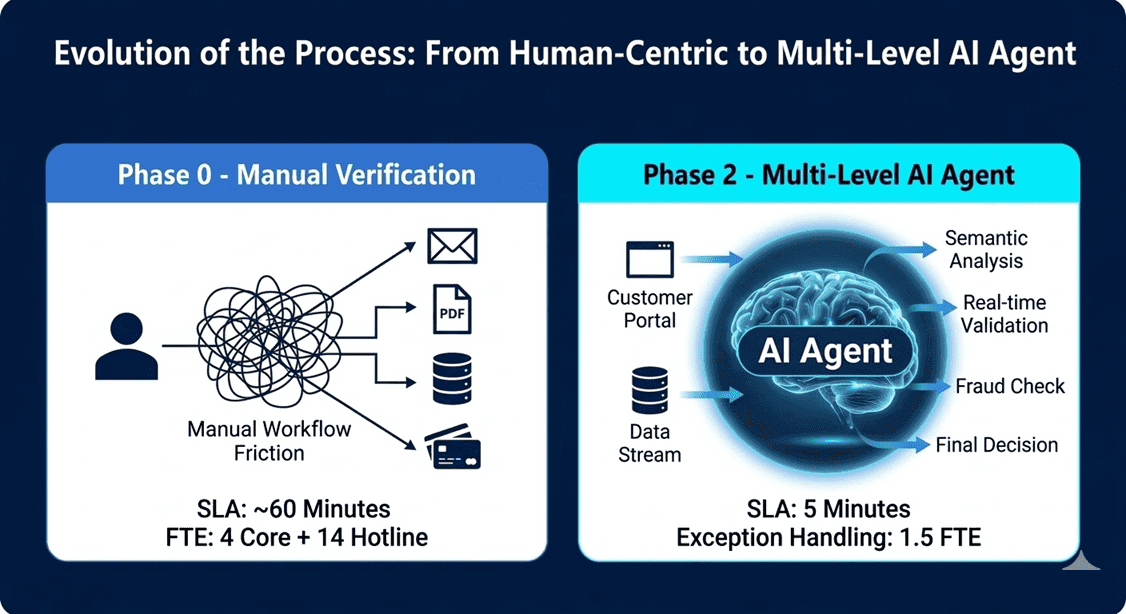
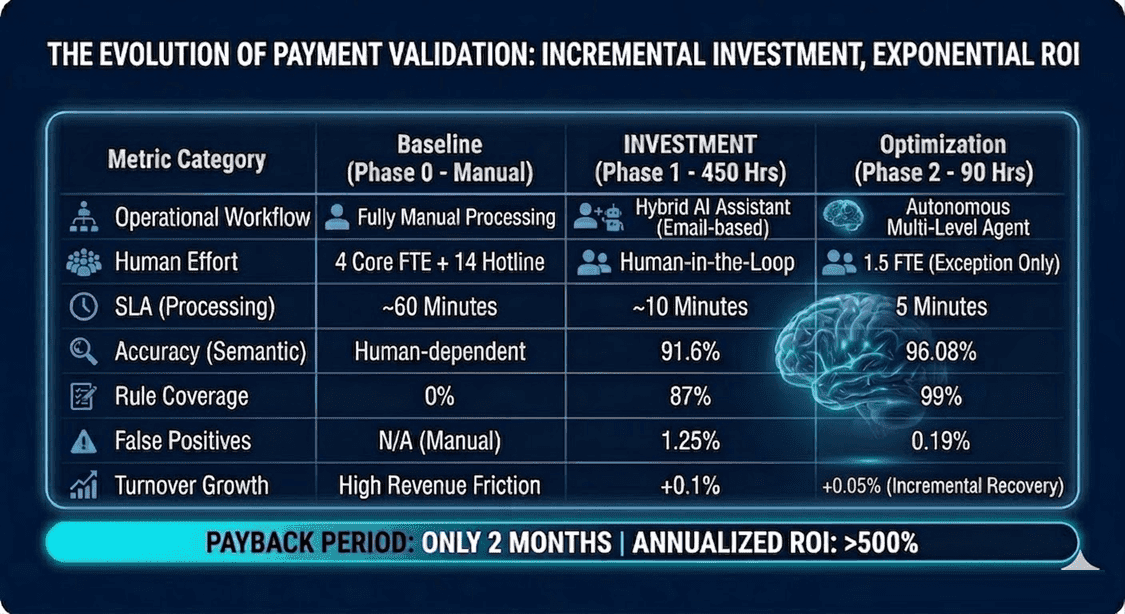
Historically, confirming customer payments and placing advance funds was a manual operation. At its baseline (Phase 0), the process was handled by a core team of four FTEs, supported by a 14-person hotline team. This setup did not provide continuous 24/7 coverage, leaving gaps in service availability.
Each request required a human operator to review unstructured PDF confirmations, validate credit limits, and verify data across multiple legacy systems. The average processing time was approximately 60 minutes.
In the fuel card business, this delay has a direct consequence: no available funds mean no refueling. For a logistics client, this interruption is critical, often forcing them to use alternative payment methods. What appeared to be an operational inefficiency was, in fact, a revenue leakage of approximately 0.15% of total turnover.
Building the “Humanless” engine: From assisted automation to autonomous agency
To move beyond simple task automation, we engineered a Multi-level AI Agent capable of sophisticated, autonomous decision-making. We intentionally opted for a high-performance Linux-based environment (PostgreSQL, Next.js, and containerized Python) to ensure maximum agility and scalability.
The agent’s architecture evolved through two critical phases:
- Phase 1: The Intelligent Framework: We focused on a semantic layer to interpret financial context. We achieved 91.6% accuracy and covered 87% of manual rules. SLA dropped to 10 minutes, reducing operational blocks by 0.1% of turnover.
- Phase 2: The Autonomous Leap: We shifted to direct portal integration. Accuracy reached 96.08% and rule coverage hit 99%. With false positives down to 0.19%, we transitioned to autonomous decision-making: 88% of all decisions are now handled fully touchless. Service Level Agreement (SLA) reached a record 5 minutes.
The Agent operates across three distinct architectural layers: a Semantic Layer (utilizing LLMs for context), a Validation Layer (real-time Core API integration), and an Autonomous Decision Layer (multi-step logic gate for fraud and risk assessment).
Governance, risk, and the human-in-the-loop
Autonomy in a financial workflow does not imply a lack of control; rather, it shifts the focus of oversight toward exception management. We implemented a multi-stage logic gate within the Autonomous Decision Layer to classify transactions based on confidence thresholds.
Any transaction exhibiting anomalies or low semantic confidence is automatically routed to a specialist. This “audit trail” ensures that while the majority of the volume is processed at machine speed, high-risk cases remain under strict human supervision, maintaining the integrity of our financial operations.
The CDO-COO partnership: Scaling operational excellence
A project of this magnitude required tight strategic alignment. The Chief Operating Officer (COO) was the primary business owner of this transformation. While the Data team provided the “engine,” the COO’s office was responsible for redefining operational roles.
The hotline and back-office teams transitioned from “data entry checkers” to “exception specialists.” This partnership ensured that the AI wasn’t just a technical success, but a business reality that could scale 24/7. The efficiency gains were so immediate that the payback period was only 2 months, representing an annual ROI of over 500%.
Conclusion
Successful AI adoption in 2025 is about removing the human capacity ceiling from growth-critical processes. By transforming a manual workflow into an autonomous agent, we proved that AI’s greatest value lies in its ability to accelerate the “velocity of money.”
When financial processes operate faster and more reliably, transaction continuity improves, and revenue follows. The real value of AI is not in automation itself, but in its ability to expand the operational capacity of the business. When the CDO and COO align around this goal, AI stops being an experiment and becomes a core driver of scalable growth.
About the Author:
Andrii Vasyliev is Chief Data and Analytics Officer at E100. With over 15 years of experience, his achievements include building data and AI platforms from scratch, implementing principles of data governance and management, and creating data-driven products that add significant value to organizations.



 Elevate Your Personal Brand