
Webinar | AI is Increasing Demand: Can Your Access Model Respond in Near Real Time? Discover how to eliminate ticket-driven bottlenecks and securely scale machine-speed data access.
The State of AI Reliability: Why Trust Is Becoming the Biggest Barrier to Scaling AI AI adoption is accelerating across the enterprise, but reliability is lagging. In a new research report, The State of AI Reliability: Perspectives from Data & AI Leaders, CDO Magazine, in partnership...
CDO Magazine Announces the Top 30 Healthcare Innovators 2026 Across healthcare, AI has moved from experimentation to enterprise execution. CDO Magazine recognizes the Top 30 Healthcare Innovators 2026 who are turning that shift into measurable impact. This year...
Opinion & Analysis
How CDOs Can Quantify the Cost of Underfunding Data in the AI Era

Written by: Sujay Dutta | Data & AI Advisor
Updated 3:50 PM UTC, May 21, 2026

When Chief Data Officers (CDOs) enter the boardroom to secure funding for data initiatives, they encounter a persistent paradox: everyone agrees that data is the foundation for AI success, yet data operations are considered a cost center.
CDOs are pressured to provide return on investment (ROI) projections. However, data is pervasive, it is generated and consumed through every business process and is critical for every AI application. Accurately isolating and quantifying the financial return is impossible.
This challenge becomes a critical roadblock as enterprises chase their AI ambitions. AI success is achieved when enterprises scale the application of AI vertically within and horizontally across their business functions to accelerate their enterprise value (EV).
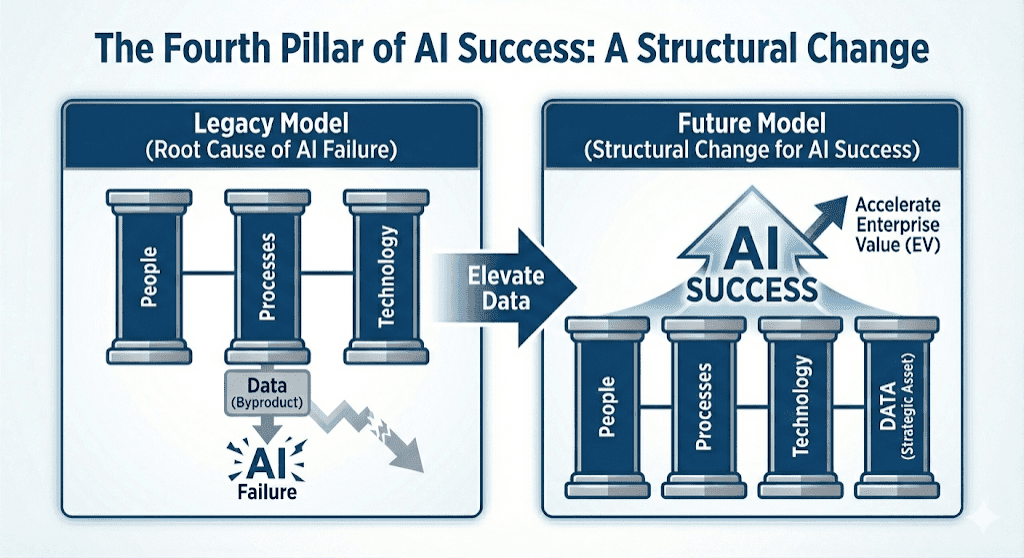
With data and its context being the critical ingredient for AI, enterprises’ three-pillared operating model of People, Processes, and Technology, treats data as a subservient byproduct. This is the root cause of AI failure.
To succeed by design, organizations need to make a structural change: elevating Data as the fourth pillar of their operating model, alongside People, Processes, and Technology. That elevation enables data to be managed as a true strategic asset.
So, how can the roadblock be cleared?
How do CDOs secure funding for this structural change when traditional return on investment metrics cannot be applied?
The solution lies in CDOs reframing the boardroom conversation from “return on investment” to two existential risks for their enterprises: the Risk of Inaction and the Risk of Incorrect Action.
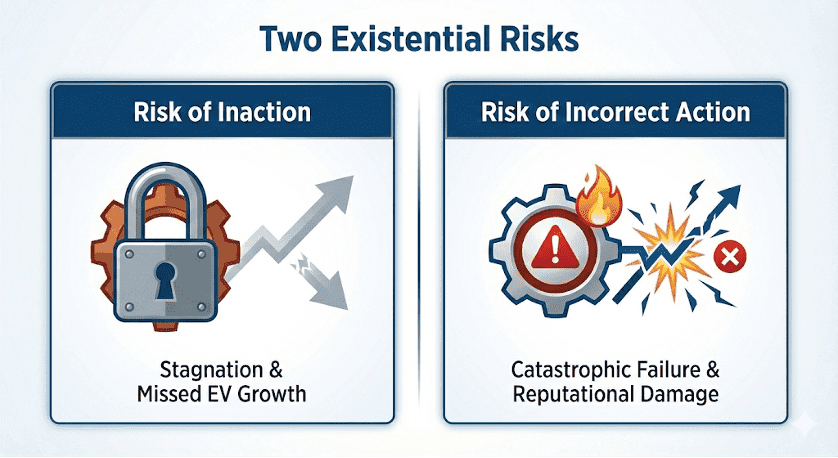
Figure: The Risks of Inaction and Incorrect Action
ROI 1 – The Risk of Inaction
This first risk emerges through inaction: when enterprises continue with their legacy three-pillared operating model in the AI-first age. Failing to fund the data as the fourth pillar ensures that data silos persist and risks EV growth by preventing the “flywheel effect” between people, processes, technology, and data that AI success demands.
To quantify this risk, CDOs should introduce a new strategic metric to the CEO and the Board: Total Addressable Value (TAV) through data. It captures the total potential business value that could be unlocked by leveraging data across all use cases and strategic initiatives. The value is gauged vertically within a business function and horizontally across business functions.
Example: Insurance company
A global insurance company identified $400M in TAV across use cases including: fraud detection, claims automation, underwriting optimization, customer churn prediction, and personalized customer offers. However, due to fragmented data silos, these initiatives were delivering only $75M in Realized Value (RV).
The Value at Risk (VAR) due to inaction is the $325M gap between the TAV and the RV. Each day without a funded data pillar increases the risk to EV growth as customers’ expectations go unmet and competitors move faster.
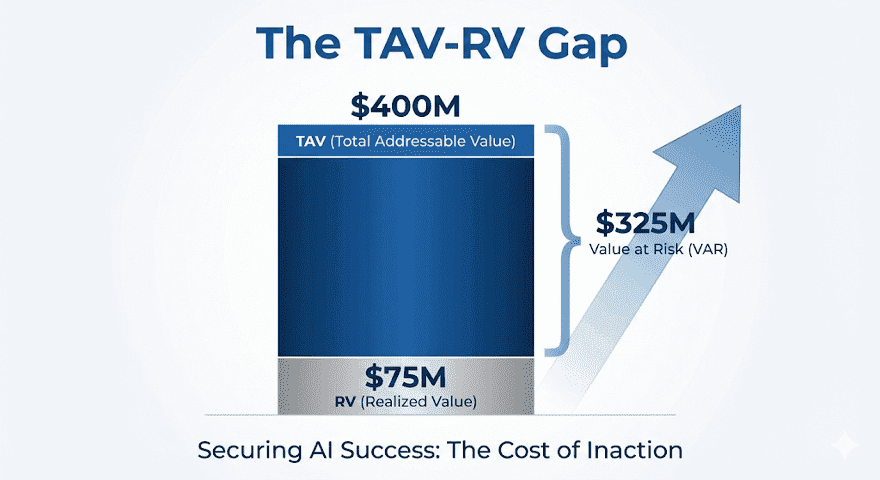
When the CDO presented this $325M VAR to the CEO and the Board, the conversation shifted immediately to “Why are we leaving $325M on the table and how do we recoup it?”
When the data pillar is underfunded, enterprises fail to build data capabilities and operationalize the Data Operating Model (DOM). DOM is the systematic framework that supplies data and its context to use cases and initiatives, at their required data intensity. Without this supply, the gap between the TAV and RV continues to widen, stakeholder expectations (including customers) go unmet, and the VAR due to inaction increases consistently.
ROI 2 – The Risk of Incorrect Action
While the first risk focuses on missed opportunities, the second risk addresses the potential for catastrophic failure. To illustrate this risk, CDOs can use the QCS Framework for Data Intensity:
- Quality: Accuracy, completeness, consistency, and timeliness of data
- Compliance: Adherence to external regulations and internal policies
- Speed: Latency of data delivery at the point of consumption
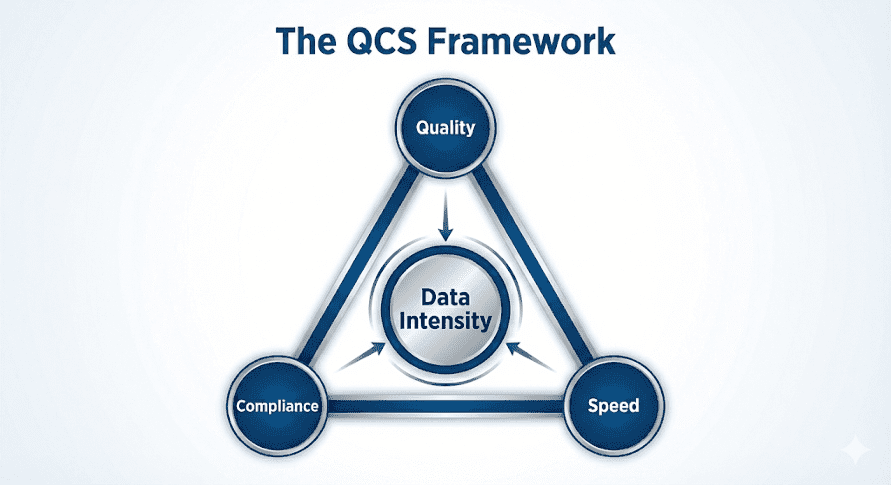
The Risk of Incorrect Action is the probability of damaging the enterprise by supplying use cases and initiatives with data that does not fulfill their required data intensity.
Example (continued): Insurance Company
Returning to our insurance provider, the firm leveraged AI agents to provide personalized offers to customers and answer queries about those offers. The insurance company faces the following risks of incorrect action by not fulfilling data intensity requirements:
- Risk due to low speed (Latency trap): If the use case receives data high in quality and compliance, but at low speed, the AI agents will be slow in making personalized offers and answering queries. Customers will not accept such offers.
This will result in lost revenue, market share, and a damaged reputation.
- Risk due to low compliance (Governance failure): If the use case receives high-quality data at high speed, it makes accurate personalized offers quickly and addresses queries promptly.
But if the compliance requirements are not fully addressed, such as using customers’ personal data without prior consent, this can result in regulatory penalties, legal claims from customers, lost revenue, and a tarnished brand.
- Risk due to low quality (Hallucinations): If the use case receives data high in compliance at high speed, but low in quality, the AI agents will make wrong offers and answer queries inaccurately at high speed. This will result in lost revenue and damaged reputation.
The Risk of Incorrect Action isn’t merely operational, it is existential.
How to position the data pillar as critical for existence
In the AI-first era, Data Pillar is not a luxury, it is a requirement for survival. To secure the sponsorship of the CEO and the Board for the data pillar, the CDO must position it as essential for mitigating both the Risk of Inaction and the Risk of Incorrect Action.
This involves two primary strategic actions, leveraging the data pillar:
1. Minimize the VAR due to inaction
The CDO must collaborate with the business stakeholders and prioritize high-impact use cases to identify the Expected Addressable Value (EAV), the subset of TAV targeted for the next planning period.
Case Study: Insurance Roadmap.
The insurance company mentioned earlier prioritized three use cases representing $200M in EAV to be targeted in the next 12 months:
- Reducing fraudulent claims by $50M
- Reducing operational costs in claims processing through claims automation worth $100M
- Increasing premium revenues through personalized customer offers by $50M
The data pillar will develop the data capabilities like data product development, semantic data management, and master data management, and operationalize the DOM to convert that EAV into increased RV.
The CDO presents this as a clear value progression to the CEO and the Board:
- We have identified $400M in TAV, of which we currently have RV of only $75M
- We are targeting $200M in EAV over the next 12 months
- Based on our current maturity, we project converting 70% of EAV to RV, delivering $140M of incremental RV
- We will reduce the VAR from $325M to $185M in the next 12 months
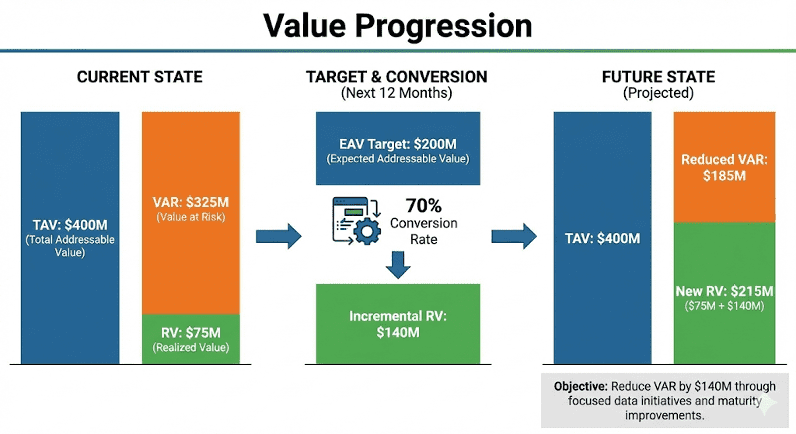
This projected EAV to RV conversion will happen only when the data intensity requirements of the prioritized use cases are met.
2. Understanding and delivering the required data intensity
Simultaneously, the CDO must engage with the business stakeholders to understand their data intensity requirements: the specific QCS (Quality, Compliance, Speed) requirements for each prioritized use case.
The DOM is then calibrated to ensure the data supply meets those requirements, preventing incorrect actions.
For the insurance company, it meant that its prioritized use cases received high-quality, compliant data at their required speed, enabling it to realize the projected EAV to RV conversion, maintain happy customers, prevent reputational damage, increase market share, and ultimately increase its EV.
The path forward: developing and executing a maturity journey
Establishing data as the fourth pillar is a journey that requires sustained investment and leadership commitment. CDOs should develop it in three stages:
- Fundamental (building the foundation): Establishing core governance, architecture, and “Source of Truth” Foundations
- Scaled (enabling self-service): Enabling enterprise-wide self-service and decentralized data ownership
- Automated (AI agents throughout the data pillar): Integrating AI agents directly into the data lifecycle (DataOps) to manage scale and complexity
Before beginning the journey, CDOs must assess the current position of their enterprise and execute a structured change management plan to improve maturity throughout the journey.
Disclaimer: The core frameworks and strategic insights presented in this article are based on the book Data as the Fourth Pillar: An Executive Guide for Scaling AI (CRC Press/Taylor & Francis), co-authored by Sujay Dutta and Siddharth Rajagopal. The views expressed herein are personal and do not reflect the positions or policies of any current or former employers. AI tools have been used to generate the images used in the article.
About the Author:
After 25+ years partnering with Fortune 500 and Global 2000 leaders, Sujay Dutta has identified a structural barrier preventing organizations from succeeding in the AI-first era: they fail to establish a strategic flywheel connecting People, Processes, Technology, and Data, across their business functions/units.
The insight is simple but radical: Data becomes the Fourth Pillar only when Boards and C-suites govern it with the same rigor applied to People, Processes, and Technology.
Dutta’s A.B.C.D. Framework (AI, Business Outcomes, Culture, Data) operationalizes this shift. It’s the blueprint for the organizational transformation leaders need to architect today.



 Elevate Your Personal Brand