
CDO AI Forum – Chicago – Westin Chicago River North – June 22, 2026 Join top AI and Data leaders in Chicago to explore the strategies, governance, and innovations driving enterprise performance. Connect, learn, and gain actionable insights — reserve your seat today.
The State of AI Reliability: Why Trust Is Becoming the Biggest Barrier to Scaling AI AI adoption is accelerating across the enterprise, but reliability is lagging. In a new research report, The State of AI Reliability: Perspectives from Data & AI Leaders, CDO Magazine, in partnership...
CDO Magazine Announces the Top 30 Healthcare Innovators 2026 Across healthcare, AI has moved from experimentation to enterprise execution. CDO Magazine recognizes the Top 30 Healthcare Innovators 2026 who are turning that shift into measurable impact. This year...
Opinion & Analysis
Agentic AI Governance: 3 Ways Data Governance Must Evolve for Autonomous AI

Written by: Sriramprabhu Rajendran | Senior Manager, Software Engineering, Capital One
Updated 8:50 AM EDT, June 16, 2026

Organizations are no longer questioning whether to embrace generative AI. They are only questioning how much autonomy they should grant AI systems. The transition from AI being merely a tool to an autonomous player is happening rapidly. And it’s revealing a governance challenge that companies are ill-prepared to face.
The response to an input from a human user by an AI chatbot is evaluated by that same human user. The AI agent, on the other hand, works differently: it breaks down the goal into tasks, accesses context, decides, and acts through various systems. The output is then evaluated by the human, if it even is.
This marks an inflection point in agentic AI governance for the data and AI leaders.
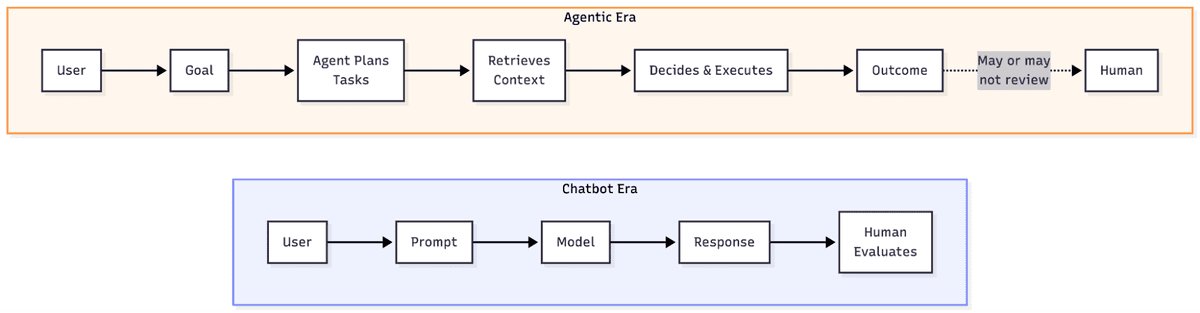
Figure: Chatbot vs. autonomous agent: The governance shift
The agentic AI governance gap: Governing data in context, not just data at rest
The traditional approach to data governance emphasizes data at rest. Businesses spend money cataloging, determining provenance, setting access restrictions, and implementing data quality policies to manage warehouses and analytics tools. This is crucial but insufficient for the agentic age.
An agentic AI queries dynamic information when making decisions. The AI pulls from databases, document repositories, and enterprise systems.
The new issue facing governance is not whether the information in the warehouse is correct. Instead, it’s whether the information used by an agent in its decision process was timely, complete, and proper.
This is an inherently more difficult question and scales proportionately with the number of agents that a business has built.
For example, an AI agent is responsible for producing a compliance report after retrieving policy documents from the knowledge base. If the system holds an old and current version of the same policy document, the agent might use both in its decision-making process. The report would be entirely correct, but reference obsolete requirements. There was no model hallucination involved; the model was functioning as intended.
Given my extensive experience over two decades designing enterprise-level distributed computing systems, I have noticed a trend that is prevalent throughout the industry. The most dangerous forms of AI system malfunctions do not result from incorrect modeling but rather from incorrect contexts.

Figure 2: How context failures bypass traditional governance
How the CDO’s role must evolve
Effective Agentic AI Governance increases the scope of leadership responsibilities beyond managing data assets to governing how AI systems process, interpret, and act on data. Organizational competencies required are:
- Cross-functional AI governance models that combine the governance of data, engineering, security, and compliance to ensure AI reliability.
- Real-time data quality governance that goes beyond batch-level validation to ensure the quality of information processed in the decision-making process of the AI agent.
- AI governance metrics for autonomous risk: Not only data quality metrics, but agent decision-making consistency, retrieval accuracy, and variation in outcomes.
- Designing explainability: The ability to reconstruct, from any stakeholder or regulatory perspective, how an AI agent made a certain decision. Explainability can’t be retroactively engineered; it should be integrated into the architecture of the agent from the beginning.
The CDO who is responsible for tying together data governance and agentic AI will dictate how their organization approaches scalable autonomous AI. The CDO who sees agentic AI as somebody else’s issue will discover that their governance holes multiply too quickly to fill.
The window is closing
In all fields, organizations are embracing the autonomy of AI capabilities. Leading firms have started to employ agents for processes related to compliance, customers, and data pipelines. The challenge is no longer about whether this paradigm shift will occur. The challenge is about leading versus lagging in the matter of governance.
Companies that design their agentic AI infrastructure with built-in governance can move forward with full assurance in highly regulated scenarios. Those that delay will develop systems that are un-auditable, uninterpretable, and ultimately, un-trustable.
The age of the agent is here. The governance mechanisms designed for the age of analytics will not be enough. By acting now, data practitioners will determine their organization’s competitive advantage in the coming years.

Figure 3: The 3 governance shifts for agentic AI
How the CDO’s role must evolve
Effective Agentic AI Governance increases the scope of leadership responsibilities beyond managing data assets to governing how AI systems process, interpret, and act on data. Organizational competencies required are:
- Cross-functional AI governance models that combine the governance of data, engineering, security, and compliance to ensure AI reliability.
- Real-time data quality governance that goes beyond batch-level validation to ensure the quality of information processed in the decision-making process of the AI agent.
- AI governance metrics for autonomous risk: Not only data quality metrics, but agent decision-making consistency, retrieval accuracy, and variation in outcomes.
- Designing explainability: The ability to reconstruct, from any stakeholder or regulatory perspective, how an AI agent made a certain decision. Explainability can’t be retroactively engineered; it should be integrated into the architecture of the agent from the beginning.
The CDO who is responsible for tying together data governance and agentic AI will dictate how their organization approaches scalable autonomous AI. The CDO who sees agentic AI as somebody else’s issue will discover that their governance holes multiply too quickly to fill.
The window is closing
In all fields, organizations are embracing the autonomy of AI capabilities. Leading firms have started to employ agents for processes related to compliance, customers, and data pipelines. The challenge is no longer about whether this paradigm shift will occur. The challenge is about leading versus lagging in the matter of governance.
Companies that design their agentic AI infrastructure with built-in governance can move forward with full assurance in highly regulated scenarios. Those that delay will develop systems that are un-auditable, uninterpretable, and ultimately, un-trustable.
The age of the agent is here. The governance mechanisms designed for the age of analytics will not be enough. By acting now, data practitioners will determine their organization’s competitive advantage in the coming years.




 Elevate Your Personal Brand