
What Is a Chief Data Officer in 2026? Many people working within the data industry are saying the same thing: the role of the Chief Data Officer (CDO) has changed – but how? CDO Magazine began an expert survey to find out. We recent...
Generative + Agentic AI: Moving From Experimentation to Enterprise Scale Generative and agentic AI are making their way into enterprise production, bringing new questions for Chief Data Officers (CDOs) and other data and AI leaders responsible for making these technologies...
Webinar | The Agentic Mindset Shift: How to Onboard an Agentic Data Team Three sessions, real playbooks, proven results you can replicate.
Branded Content
You Can’t Build Trustworthy Agents on Untrustworthy Data
Learn how data intelligence helps enterprises secure, govern, and scale agentic AI from experimentation to production.

Written by: Ashish Gupta | General Manager, Data Management at Everpure
Updated 8:00 AM EDT, October 28, 2026

Every enterprise data leader entered 2026 with a clear directive: provide the data foundation needed to safely put autonomous agents into production to deliver real business value.
The promise of agentic AI is undeniable. But as organizations rush to deploy these systems, a familiar wall has emerged. Most enterprise agentic initiatives stall at the experimentation phase.
When projects stall, the knee-jerk reaction is to blame the models, point to context window limitations, or lament the difficulty of prompt orchestration. But IDC’s global research, commissioned by Everpure, points to a simpler, harder truth: the primary bottleneck to agentic AI isn’t the agent. It’s the trust and accessibility of the data beneath it.
According to IDC’s global study, Why AI Projects Fail: Revealing the Data Infrastructure Gap (surveying 1,300+ enterprise IT and AI decision-makers), the top two barriers to implementing agentic AI are data security (41%) and real-time data access (39%).
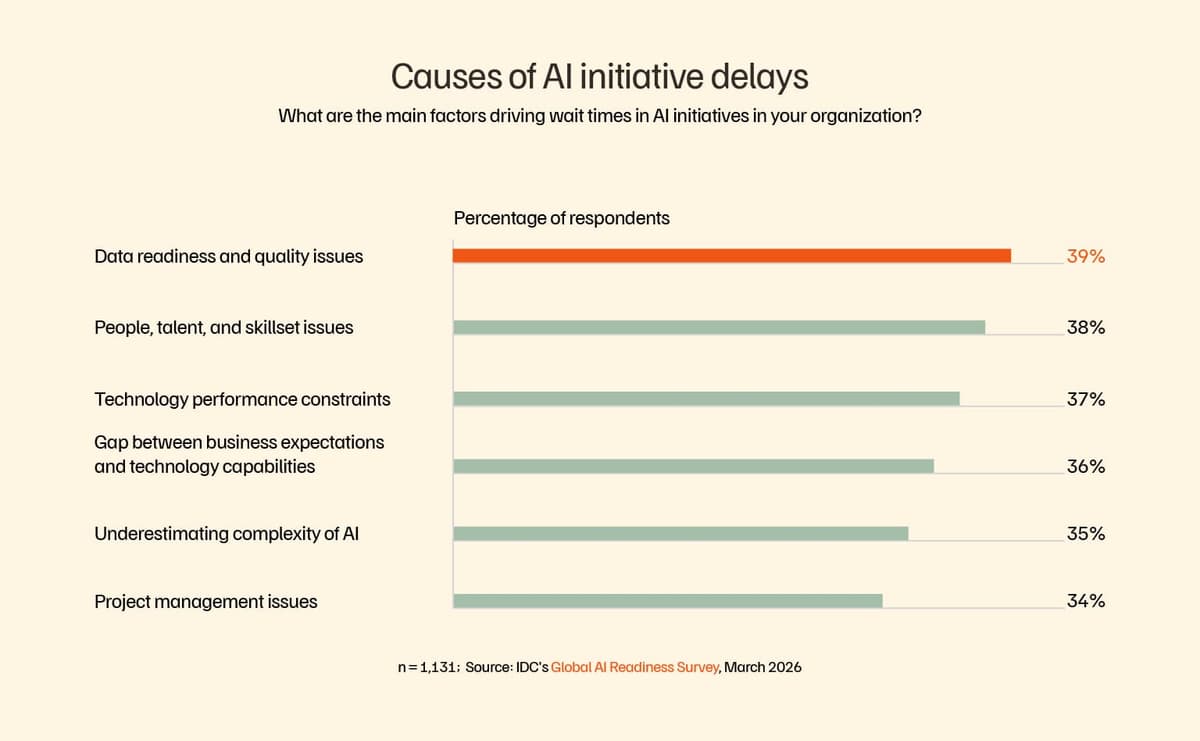
To most risk committees and CISOs, those two statistics sound like an inherent conflict: Agents require broad access to enterprise data to reason accurately, but giving them broad access creates unacceptable security risk.
The common enterprise reflex is to treat data governance as a mandatory brake—a compliance tax that deliberately slows deployments to keep the organization safe. We make the opposite case: data intelligence isn’t a brake on agentic AI; it’s the accelerator.
The core paradox of the autonomous agent
An AI agent operates in a continuous loop: it observes data, reasons over its context, decides on an action, and executes that action across enterprise systems.
When an agent hallucinates in a consumer chat app, it’s an annoyance. When an enterprise agent hallucinates while interfacing with your supply chain, customer service database, or financial ledger, it’s an operational catastrophe.
Because agents act autonomously, they magnify both the value of accurate data and the risk of unvetted data. Consider the dual mandate every AI leader faces when bringing an agent to the risk committee:
- The reach problem: To make an accurate decision, an agent needs real-time, low-latency access to structured and unstructured operational data across silos. If the data is obsolete, siloed, or lagging, the agent reasons on false assumptions.
- The guardrail problem: To prevent an agent from executing unauthorized tasks, leaking sensitive personally identifiable information, or breaching compliance, it must be bound by strict access controls, dynamic masking, and Zero Trust data policies.
If you view governance as an administrative overlay tacked onto the storage layer after the fact, these two requirements will always be at war. You will either restrict data access so severely that the agent becomes useless or open up access so broadly that your risk committee vetoes production.
Data intelligence: Turning governance into an AI accelerator
The solution isn’t to build a flashy AI operating system layer on top of a messy, fragmented data estate. The solution is data intelligence—knowing precisely what your data is, where it lives, whether it can be trusted, and who (or what) is authorized to see it.
Instead of viewing governance as a passive rulebook, data intelligence bakes lineage, classification, context, and security directly into the data logistics pipeline.
When you establish a unified, context-aware data layer, governance transforms from an obstacle into a green light:
- Granular policy enforcement at the data layer
When data inspection, provenance tracking, and metadata enrichment happen automatically at ingestion, agents don’t need hardcoded, brittle permission logic. The infrastructure dynamically governs what data is visible to an inference job or an agent action based on Zero Trust parameters. - Eliminating the “garbage in, rogue action out” loop
The IDC study found that 94% of survey respondents consider data quality decisive to AI success. The top contributors to poor data quality—redundant data, storage silos, and obsolete data—are lethal to agentic reasoning. A context-aware data platform actively catalogs obsolete data and flags it for retirement under your retention and legal-hold policies, so agents reason on current operational facts. - Giving risk committees attributable proof
You can’t gain approval for an autonomous workflow with a high-level pitch about model intelligence. Risk committees require proof: Can you trace why the agent took this action? Can you prove it didn’t access unauthorized records? Data intelligence provides end-to-end auditability and data provenance, allowing security teams to say “yes” to production deployments faster.
Governance is your strategic AI advantage
As agentic models commoditize and equalize across the market, your competitive advantage will not come from the orchestration framework you select. It will come from the trust, currency, and intelligence of your enterprise data.
IDC’s research reveals that 45% of organizations are already planning or actively piloting a unified data platform to bridge this exact gap. The organizations that treat data governance as a strategic differentiator will be the ones shipping autonomous agents that drive real business ROI. Those that treat it as an afterthought will remain stuck in pilot purgatory.
An agent is only as reliable as the data it reasons and acts on. If you want to build agents your business can truly trust, start by building a data foundation that earns that trust.
Build agents your business can trust.
IDC’s study of 1,300+ enterprise IT and AI decision-makers, commissioned by Everpure, examines the data infrastructure gaps holding agentic AI back and what leaders are prioritizing to close them.



 Elevate Your Personal Brand


