
What Is a Chief Data Officer in 2026? Many people working within the data industry are saying the same thing: the role of the Chief Data Officer (CDO) has changed – but how? CDO Magazine began an expert survey to find out. We recent...
Generative + Agentic AI: Moving From Experimentation to Enterprise Scale Generative and agentic AI are making their way into enterprise production, bringing new questions for Chief Data Officers (CDOs) and other data and AI leaders responsible for making these technologies...
Webinar | The Agentic Mindset Shift: How to Onboard an Agentic Data Team Three sessions, real playbooks, proven results you can replicate.
Artificial Intelligence
The $40,000 Question: How CDOs Can Cut AI Waste Without Cutting Ambition

Written by: Raghuvar Karthik Durga | Strategic CTO & Senior Account Technology Strategist, Microsoft
Updated 8:00 AM EST, November 5, 2026

“One of my engineers spent $40,000 on tokens last month, and I genuinely don’t know whether I should stop him or if I should go and tell everyone else to be like him.”
A chief technology officer shared that dilemma with the CEO of an engineering operations platform, TechCrunch reported in June. Many AI leaders now face a version of it.
Uber used up its 2026 AI coding budget by April, TechCrunch also reported. In a Gartner survey released in October 2026, only 13% of CIOs reported their enterprise has realized significant or transformational value from AI. In Ramp’s September AI Index, frontier models fell from a 53% August peak to 45% of business token volume.
Rationing is understandable, but it’s also risky. A blanket cap cannot tell an agent stuck in a loop from an engineer building next year’s revenue. Cut both, and you save money while losing the reason you invested.
In my conversations with chief data officers (CDOs) and chief information officers (CIOs), AI cost has moved from a footnote to one of the first questions. My answer is that AI cost is now a data problem. What an agent reads, which work can move to a cheaper model, and where sensitive tasks may run are all data decisions. Yet in the Tokenomics Foundation’s 2026 survey of nearly 500 companies, only 6% named AI leadership, including the CDO, as the owner of AI economics. Companies with any defined owner were 3.7 times more likely to show value.
The goal is not to spend less on AI. It is to waste less, so the enterprise can spend more where AI earns.
The following seven recommendations outline how CDOs can reduce unnecessary AI spending, protect innovation, and reinvest the savings.
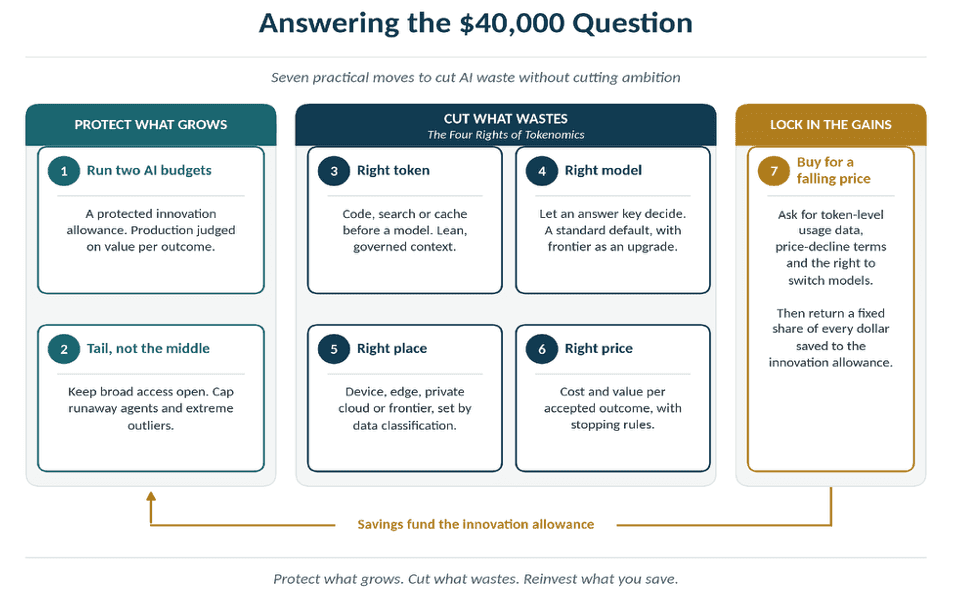
Figure 1. Seven practical moves to cut AI waste without cutting ambition. Moves 3 to 6 form the Four Rights of Tokenomics, and the savings they release fund the innovation allowance.
Protect What Grows
1. Run Two AI Budgets, Not One
Give innovation a fixed, ring-fenced allowance with access to the best models and no approval for each request. Judge it on what it learns within a time box. Give production a separate budget, judged on cost and value per outcome. One cap for both starves the experiments that become next year’s revenue.
I hear versions of this tension from most manufacturers I advise. In one working session, leaders told me business teams were prototyping applications with AI coding agents faster than IT could review them. They worried an application could cost more to run than the packaged software it replaced. I recommend a review gate before any prototype leaves the innovation budget. To earn production funding, a project needs a named owner, a passed quality test, a credible run cost per outcome, and a stopping rule. My lesson: judge a prototype by its run cost, not only by how fast it was built.
2. Manage the Tail, Not the Middle
Heavy use shows diminishing returns. Jellyfish, an engineering management platform, found the heaviest token users were about twice as productive as lighter users at 10 times the tokens. Keep broad access open. Put guardrails on the extreme tail and on unattended agents. Every agent needs a per-task budget, a step limit, and a circuit breaker. OWASP’s 2026 AI security guidance calls for caps that halt spending, not alerts that report it.
A blind spot I often see is that leaders cannot tell which model each person uses. Many people pick the most powerful option and keep going until they hit a usage limit. One leadership team told me that forcing everyone to switch tools would backfire. Instead, they sketched role-based profiles: frontier models for developers and a short list of models with automatic selection for business users. The sketch also included daily spending limits that people could exceed with approval, plus training on model choice. Another team, which had already trained its people, reported using frontier models less. My lesson: get visibility first, train people on model choice, then cap only the tail.
Cut What Wastes
I call the next four moves the Four Rights of Tokenomics: right token, right model, right place, and right price. They come from working sessions this year with IT and data leaders at large manufacturers. AI use was outrunning the data needed to manage it, and pricing was moving to usage-based billing. In one session, I summarized the need to match the right workload to the right model at the right cost while maintaining appropriate security. That idea evolved into the Four Rights of Tokenomics. I chose the term “right place” to emphasize that deciding where data can be processed is a security decision. Each right depends on a data asset the CDO can own: governed context, the answer key, data classification, and an outcome ledger.
Four questions put the framework to work on any AI workflow:
- Right token: Does this step need a model at all?
- Right model: What is the least expensive model that passes our answer key?
- Right place: Where is this data allowed to be processed?
- Right price: What does one accepted outcome cost, and what is it worth?
3. Right Token: Stop Paying Models To Do What Code Can Do
Lookups, calculations, and repeated answers belong to code, search, or a cache. When a model is needed, feed it lean, current context from governed data products.
4. Right Model: Let an Answer Key Decide
Make a capable standard model the default, with frontier models one click and a reason code away. Before moving a workflow to a less expensive model, build an answer key with the people who own the work: real tasks, reference answers, and pass marks. Move work to less expensive models only when they pass the answer key’s tests. Routing tools can now automate the choice, but only the business can write the answer key. The CDO then governs it as a data product, and no workflow should switch models or processing locations without passing the answer key’s tests.
The answer key grew out of one session’s central question: whether a cheaper model would be good enough for the work. To build an answer key, start as I do in my working sessions: with one representative workflow and the one business decision it should inform. Test security and privacy too, not just accuracy.
5. Right Place: Move Routine and Sensitive Work Closer to the Data
Not every token needs a data center. Let data classification decide. Restricted data stays on approved devices, at the edge, or on premises, and confidential data stays in a private cloud. Other workloads run in the lowest-cost environment where they pass the answer key’s tests.
Of the Four Rights, I expect “right place” to have the greatest impact on the cost structure. I now tell leadership teams to plan for laptops that run AI agents and models locally. Stanford researchers found that the best local model for each query could already answer 88.7% of single-turn chat and reasoning queries accurately.
Local is not free. In February 2026, Gartner said surging memory costs will increase PC prices by 17% compared to 2025 levels. It added that rising AI PC prices will delay the projected 50% market penetration of AI PCs until 2028. Every model on a laptop must also be secured and updated like other software. Still, routine work that runs locally moves from a usage bill to a hardware budget that finance already knows how to plan. The CDO and CIO should agree which data may be processed on devices, which models may run there, and which answer keys they must pass.
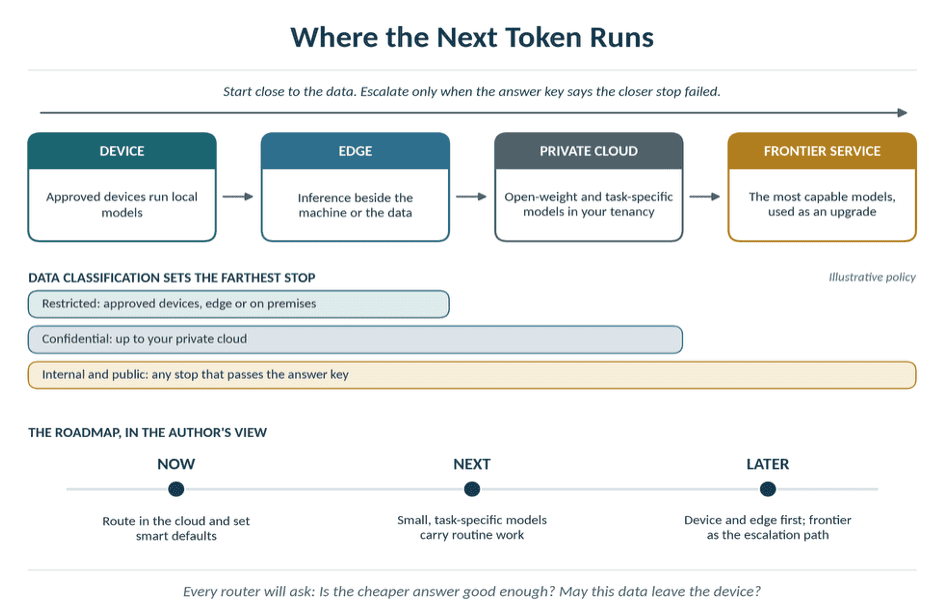
Figure 2. Where the next token runs. Data classification determines how far a request may travel, while the answer key determines when to escalate. The roadmap reflects the author’s view.
6. Right Price: Keep an Outcome Ledger, Not a Token Count
Token counts rise with adoption and say nothing about value. An outcome counts only when it meets the answer key’s pass marks. Record each accepted outcome, such as a resolved ticket or a qualified lead, with its cost and value. The CDO should own that ledger. Fund revenue-generating workflows based on their return, and then set stopping rules. In Gartner’s survey, CIOs at organizations with guidelines for determining when an AI pilot should not move to production were 2.3 times more likely to be vanguards. Gartner defines vanguards as CIOs “delivering better performance on business outcomes while also reporting high CEO-perceived AI value.” Only 31% of CIOs reported having such guidelines in place.
Lock In the Gains
7. Buy for a Falling Price, Then Reinvest the Savings
Ramp’s data shows effective token prices falling sharply from their March peak, and contracts should capture that trend. Ask for token-level usage data, price-decline terms, and the right to switch models. Then return a fixed share of every dollar saved to the innovation allowance. That turns cost control from a brake into an engine.
Get Ahead of the Budget Cut
Leaders who wait will receive a blanket cut designed by finance. Leaders who act first decide what is cut and where the savings go. Three steps for the next 30 days:
- Find the tail: the workflows, users, and agents driving outsized spend
- Build answer keys for three workflows and retest them on cheaper and local models
- Start an outcome ledger and report cost and value per accepted outcome monthly, including what was reinvested
“Volume is not value,” as Gartner analyst Alicia Mullery put it in October 2026. So the answer to the $40,000 question is neither to stop the engineer nor to copy him. It is to know what his tokens earned. Leaders who can show that and who reinvest what they save will get through the AI budget wall with their ambition intact.




 Elevate Your Personal Brand


