
What Is a Chief Data Officer in 2026? Many people working within the data industry are saying the same thing: the role of the Chief Data Officer (CDO) has changed – but how? CDO Magazine began an expert survey to find out. We recent...
2026 CDO Report: Meet the Modern Data Team New survey of VP & C-level data and AI leaders confirms what’s stalling AI transformation.
Generative + Agentic AI: Moving From Experimentation to Enterprise Scale Generative and agentic AI are making their way into enterprise production, bringing new questions for Chief Data Officers (CDOs) and other data and AI leaders responsible for making these technologies...
Artificial Intelligence
Biohub’s $1.8B AI Biology Push Shows Why Data Standards Come First

Written by: Tathagata Sen
Updated 7:13 AM EDT, October 9, 2026
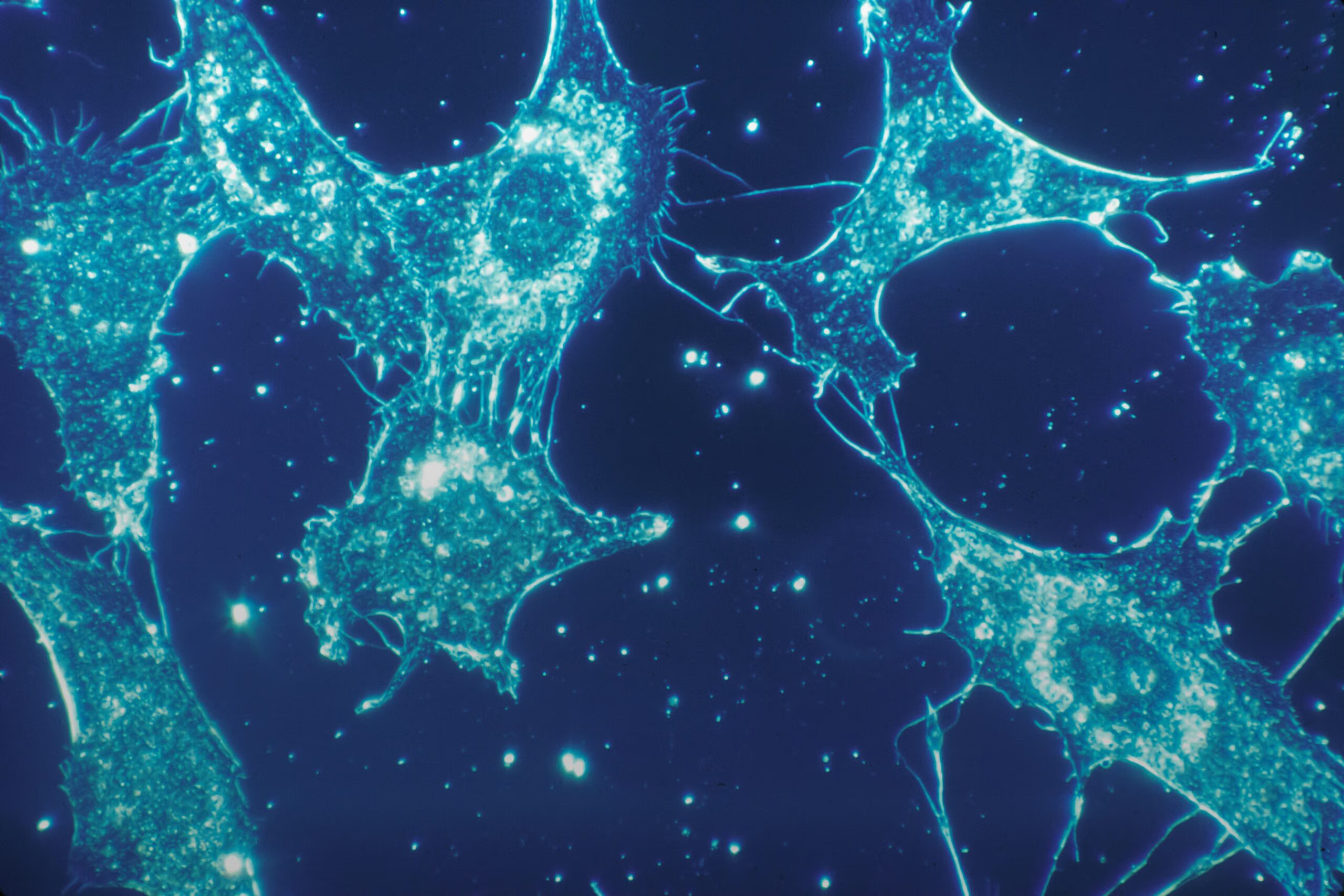
Photo credit: Unsplash.com
Biohub, a nonprofit research institute combining frontier AI and biology, the U.S. Department of Energy, the National Institutes of Health, Google DeepMind, Meta, and Isomorphic Labs are expanding the Virtual Biology Initiative, a $1.8 billion effort to create open biological datasets for training AI models, according to a Reuters report.
The aim is to build AI models that can predict how cells respond to drugs, genetic changes, and other treatments.
According to Biohub’s October 7 post, the partners will collect data using advanced imaging, cell-measurement tools, and experiments that test how cells respond to changes. They will then organize the data in one shared system, using common formats, shared identifiers, and one place for researchers to access it.
The first dataset (the first major batch of standardized biological data) is expected in about a year, and the effort is planned to run for five years.
The Department of Energy will invest more than $500 million over five years in laboratory measurements, modeling, and computing, while NIH will coordinate datasets and repositories supported by more than $500 million in earlier federal funding. Biohub will work with NIH to standardize those datasets for AI training.
Standardization Becomes a Strategic Asset
For chief data officers (CDOs), the initiative shows why AI strategy increasingly depends on the work that happens before a model is trained.
The challenge is that organizations need common standards for how data is collected, described and structured so that datasets from different research programs can be combined and used reliably.
Biohub’s role in standardizing federally funded datasets puts that work directly inside the AI development process.
Reuters reported that datasets funded by commercial partners will initially have embargo periods that give those companies early access, while government-funded work will not carry the same restrictions. The datasets are ultimately intended to become public scientific resources.
That makes data governance part of the AI strategy. As organizations build increasingly valuable datasets for model development, CDOs need clear rules around data quality, standards, and access.



 Elevate Your Personal Brand