
The Evolving Role of the Data, AI, and Analytics Executive: 2026 Benchmark Survey
Nominate Now | Top 30 Retail Data Changemakers 2026 Nominate for the Top 30 Retail Changemakers 2026, our annual recognition honoring visionary leaders who are redefining the retail landscape through data, AI, and analytics.
How to Become a Chief Data Officer A decade ago, relatively few organizations had a Chief Data Officer (CDO). Today, the role sits at the center of enterprise data, AI, and business transformation. What began as a role focused largely...
AI Governance
Beyond Data Lineage: 5 Controls CDOs Need Before AI Changes Enterprise Truth

Written by: Scott Lee | Founder & Chief Architect
Updated 10:00 AM EDT, August 25, 2026

Data lineage can show where a value came from, how it moved, and which systems depend on it. It cannot, by itself, prove that an AI agent was entitled to make that value authoritative.
That gap is now a Chief Data Officer (CDO) issue. AI agents are moving from recommendations into master-data merges, retention actions, classification changes, and direct writes to systems of record. Once accepted, those changes can affect payments, access, compliance, service, and every downstream decision that trusts the record.
CDOs therefore need decision-to-effect lineage: an auditable chain from delegated authority and current policy to the exact proposed change, the decision to accept, hold, or refuse it, and the effect that landed.
Source-to-target lineage explains how data moves. Decision-to-effect lineage adds an AI governance layer while the target system can still say no. It is a decision-rights and accountability model, not simply a new technical layer.
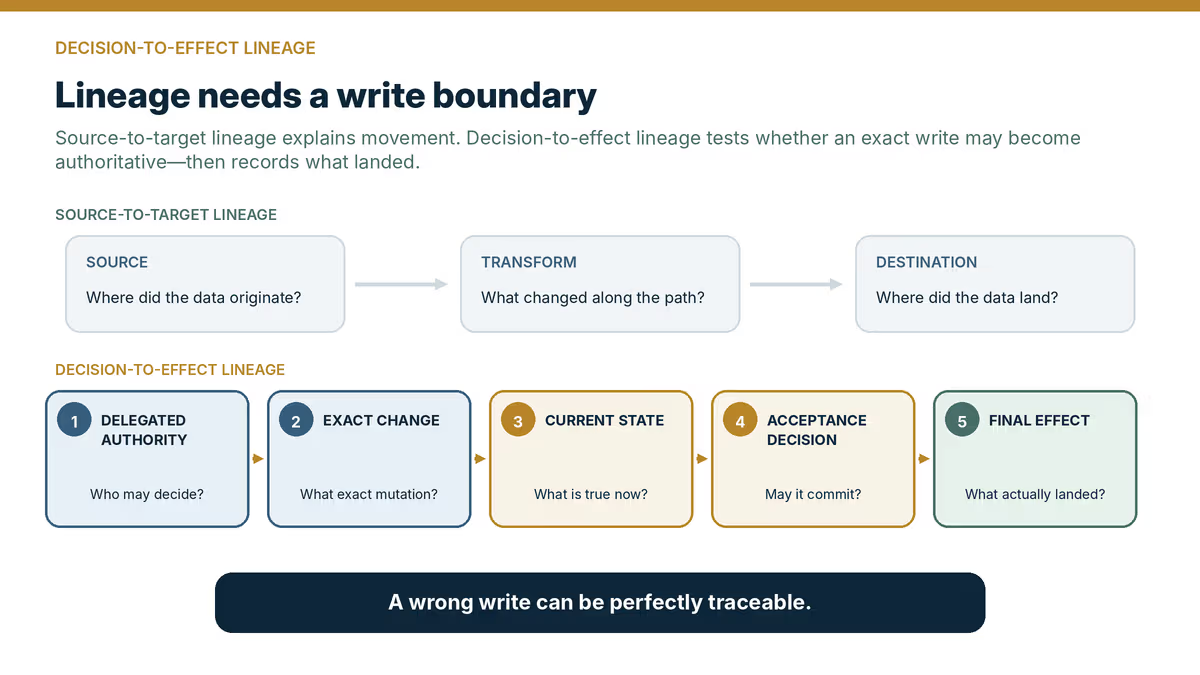
Figure 1: Source-to-target lineage explains how data moved. Decision-to-effect lineage adds a governance layer by determining whether an AI-driven write should become authoritative—and recording what happened.
Where Traditional Lineage Falls Short
Consider a master-data agent asked to merge duplicate supplier profiles. A steward approves moving address and contact fields from Supplier 1042 into verified Supplier 1047 while preserving tax and banking data.
Before execution, a fraud hold is placed on Supplier 1047, and updated governance rules now identify Supplier 1042 as the record that should remain authoritative. Yet the attempted write still targets 1047, adds an unapproved banking-field change, and is submitted again by a retry.
The agent is authenticated.
The API is approved.
The workflow is logged.
Source-to-target lineage is complete.
Yet the write should be refused.
For CDOs, the question is not whether the agent can write. It is whether this exact write should become enterprise truth now.
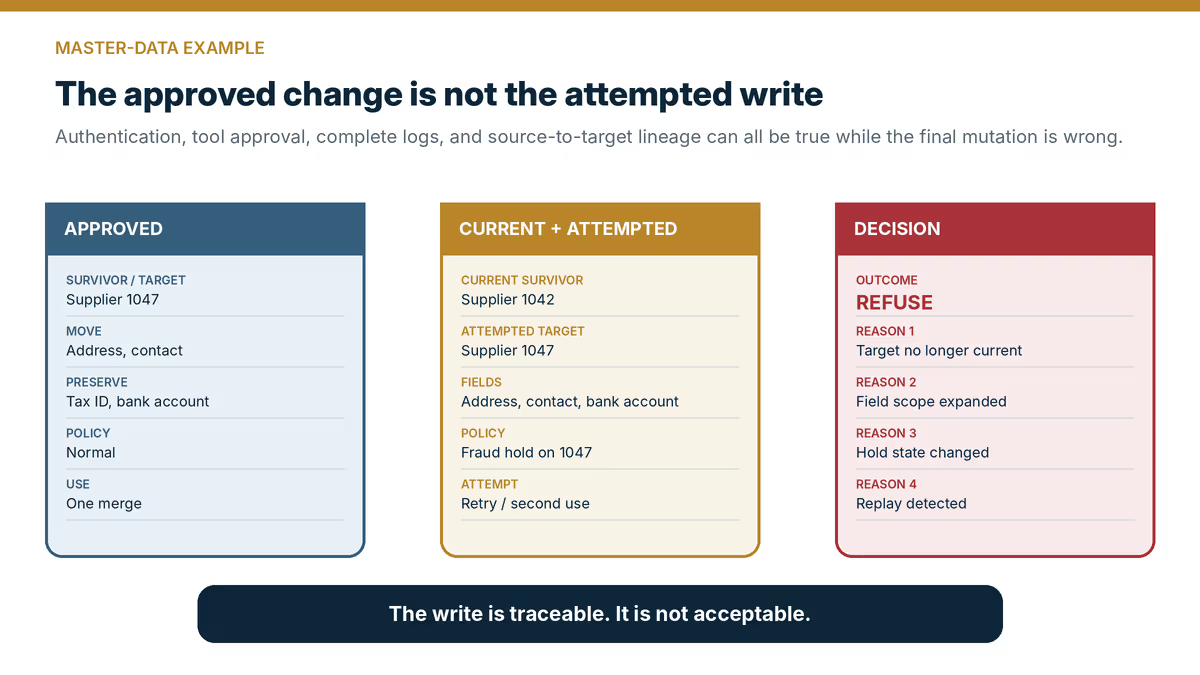
Figure 2: The supplier merge should be refused because the target, field scope, policy state, and replay status no longer match the approved change.
Five Governance Controls for AI-Driven Writes
The example above illustrates why traditional data lineage isn’t always enough. As organizations expand the role of AI agents, these five controls offer a practical starting point for governing AI-driven writes.
1. Define decision rights, not just system access
Technical access is only part of the equation. Organizations should also define the business decision rights an AI agent is authorized to exercise. That may include:
- the accountable person or function;
- the records and fields the agent may affect;
- the operations it may perform;
- any thresholds or limits;
- the intended purpose; and
- the time period during which that authority applies.
CDOs should also consider defining which changes an agent may recommend, prepare, approve, or execute, who may delegate those rights, and where that authority ends. A downstream agent or workflow should not silently expand the authority it receives.
A service account proves that a write is technically possible. It does not necessarily demonstrate that the organization authorized the business decision behind that write.
2. Approve the exact change, not a broad task
Rather than approving a broad task such as “clean up duplicates,” consider tying approval to the specific change an AI agent is expected to make. That gives business owners something concrete to review and technology teams something precise to enforce.
A reviewable change record might include:
- the target system and record;
- field-level before-and-after values;
- supporting evidence;
- the intended destination;
- the business purpose; and
- any material conditions that formed the basis for the approval.
If the target, field, value, destination, purpose, or other material condition changes, the original approval should no longer apply. The updated write should be reviewed as a new decision.
3. Confirm that the decision is still valid
Before an AI-driven change is executed, confirm that the conditions under which it was approved are still true. Ideally, this happens at the last reversible moment — the final point at which the target system can still stop the change without undoing a real-world effect.
That review may include factors such as:
- the applicable policy version;
- stewardship rules;
- consent status;
- legal or fraud holds;
- data classification;
- segregation of duties;
- revocation status; and
- the current record version.
Evidence has a shelf life. Approval based on yesterday’s conditions should not automatically authorize today’s write.
CDOs should also consider defining the evidence required for each protected write, how current that evidence must be, and what should happen when it is missing or conflicting. In many cases, routing the action for updated evidence or review may be a safer governance choice than allowing the change to proceed under uncertainty.
4. Enforce the decision where the change happens
The most effective place to enforce a decision is where the receiving system — or a control owned by that system — can still refuse the write. An agent-side check may happen too early, while monitoring after the change has already occurred is too late.
The goal is to make sure every path capable of creating the same business effect passes through an equivalent control. That might include:
- APIs;
- batch processes;
- administrative tools;
- retry workers; and
- partner integrations.
One approval should create only one authoritative effect.
Legacy systems may change how this is implemented, but they shouldn’t change the governance objective. Rather than attempting a large-scale modernization effort, organizations can start with one protected write and enforce the control at the narrowest unavoidable point in the process. Where no existing route can verify the decision and stop the effect, keeping the agent in a prepare-only mode may be the more appropriate choice.
Autonomy should stop where enforceability stops.
Activity logs can show that a call occurred. They rarely show what the receiving system evaluated before deciding whether to make that change authoritative.
A decision-and-effect record might include:
- the exact change;
- delegated authority;
- policy and evidence versions;
- the outcome (accept, hold, or refuse);
- the reason for the decision;
- the transaction identifier;
- replay status; and
- the resulting before-and-after state.
This is not about retaining every prompt or internal model trace. Instead, the goal is to capture the evidence that was reviewed, the decision that was made, and the resulting business effect—creating a record that executives, auditors, regulators, and incident response teams can use when questions arise.
Together, these controls create a simple governance chain:
Decision rights → Exact change → Current conditions → Accept, hold, or refuse → Final effect
How CDOs can start now
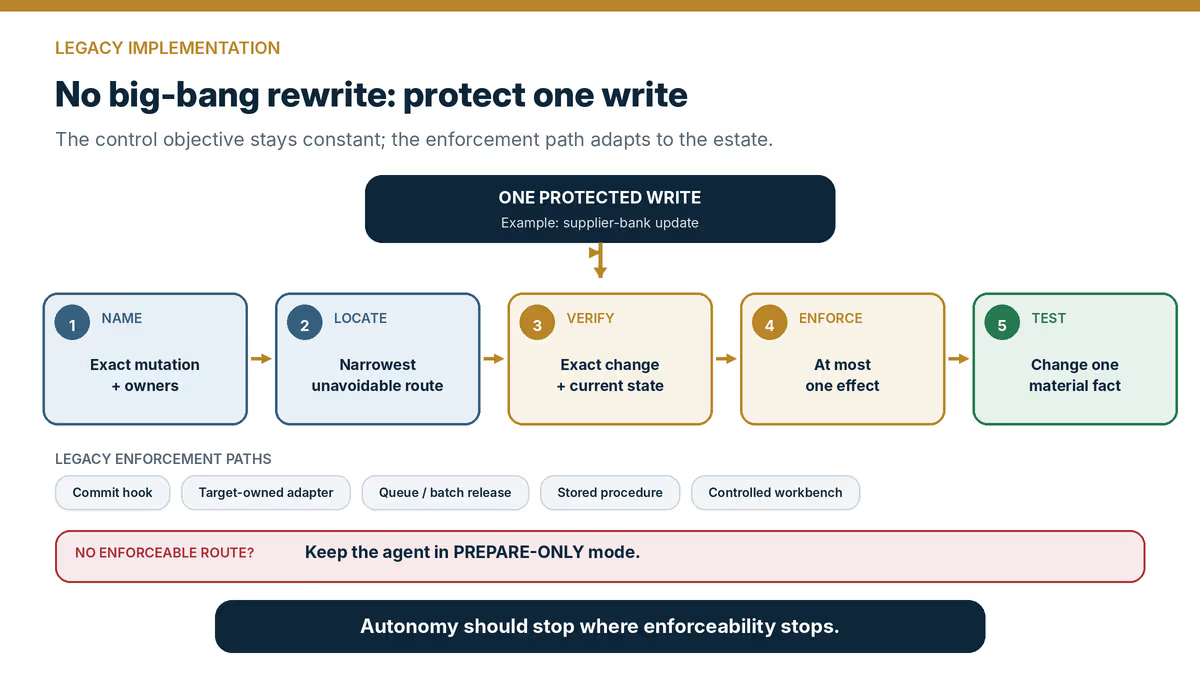
Figure 3: Organizations can begin strengthening governance one protected write at a time rather than attempting a large-scale system redesign.
Rather than trying to govern every AI-driven action at once, consider starting with a single protected write—one that affects rights, money, identity, compliance posture, operational state, or other data that downstream systems treat as authoritative. Good candidates might include supplier bank details, customer consent status, retention deletions, or an authoritative master-data merge.
From there, focus on a few foundational questions:
- Who owns the decision? Identify a decision owner who determines when a change is appropriate, an effect owner who is accountable for the receiving system and business outcome, and a control owner responsible for enforcement. While the CDO may not own every control, they can help establish the governance standards and clarify accountability across the organization.
- What outcomes should the controls support? Define clear, business-readable outcomes for each protected write. A change may be accepted when authority and supporting evidence align, held when evidence is missing or conflicting, or refused when it exceeds delegated authority or conflicts with policy.
- Can the governance controls stop a change when conditions change? One practical test is to approve a valid write, then change a single governing condition—such as a hold, survivor record, field set, consent state, or destination—and submit it again. If the system cannot consistently hold or refuse the revised write, there may be an opportunity to strengthen the governance boundary.
- How will success be measured? A small executive scorecard might include measures such as protected-route coverage, stale-state catches, bypass attempts, duplicate-effect rate, average hold age, and time to resolve held actions. Reviewing those measures through existing governance and risk forums can help embed these practices into ongoing governance rather than treating them as a separate AI initiative.
The next era of data governance will not be judged only by whether organizations can explain where data came from. It will also depend on whether they can demonstrate why one AI-driven write became enterprise truth — and why a different one did not.
Before AI changes enterprise truth, make it prove the exact change.




 Elevate Your Personal Brand