
The Evolving Role of the Data, AI, and Analytics Executive: 2026 Benchmark Survey
How to Build a CDO Career That Lasts Beyond 3 Years: Lessons From a 10-Year Stint In the Same Organization Data has never received more executive attention. Organizations are actively pouring money into data and AI, boards are demanding answers, and CEOs expect ROI. Yet Chief Data Officer (CDO) tenures are...
CDO Magazine Unveils the Top 25 Chicago Data & AI Leaders 2026 CDO Magazine proudly presents the Top 25 Chicago Data & AI Leaders 2026, recognizing the executives leading high-impact data, analytics, and AI initiatives across some of the world’s most influential...
AI Governance
Agentic AI in the Enterprise: A Blueprint for Safe Deployment

Written by: Gopalakrishnan Marimuthu | Industry Specialist
Updated 10:00 AM EDT, August 6, 2026

The Power and the Danger of Autonomous AI Agents
Agentic AI is transforming enterprise workflows. Unlike traditional AI systems that respond to queries, agentic AI systems operate autonomously – perceiving environments, making decisions, and adapting based on outcomes.
For Chief Data Officers (CDOs), the opportunities are substantial: autonomous security operations that accelerate incident response, AI agents orchestrating complex infrastructure, and agents synthesizing threat intelligence at machine speed.
Yet rapid deployment brings critical risks. A security agent compromised by prompt injection can dismiss genuine intrusions. An optimization agent with misaligned objectives can create operational cascades. An infrastructure agent without observability becomes an unauditable “black box” that violates compliance.
The difference between successful and failed deployments isn’t model sophistication; it’s a disciplined architectural approach. Safe agentic AI requires a systematic approach to input integrity, behavioral monitoring, and decision governance.
The Architecture of Trust
Safe deployment of agentic AI requires three integrated layers of control: input integrity, behavioral guardrails, and decision provenance. Together, these layers create a defense-in-depth architecture.
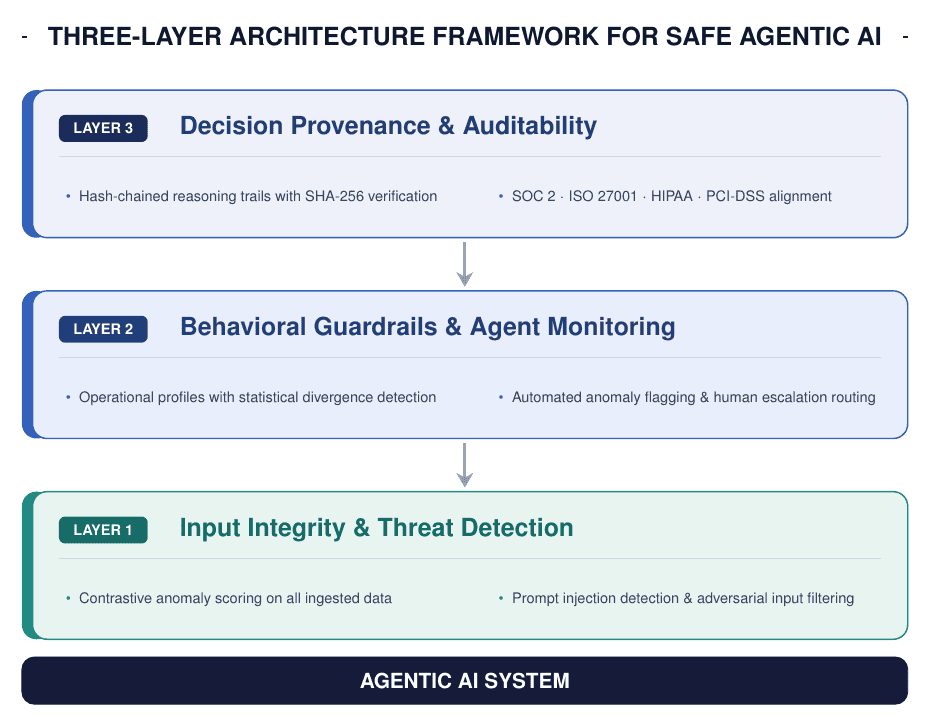
Figure 1: Three-Layer Architecture Framework for Safe Agentic AI Systems
Layer 1: Input Integrity and Threat Detection
Agentic systems are vulnerable at the data layer. Agents processing logs, threat feeds, or requests face adversarial inputs — data crafted to manipulate reasoning. Poisoned threat intelligence can cause misattribution. Malicious log entries with embedded prompt injection can instruct security agents to ignore critical incidents.
The safeguard is contrastive input validation: validating data against a reference model of “normal” behavior before it reaches the agent. Unlike signature-based filtering, it detects data that is structurally valid but semantically anomalous.
In one banking organization, input validation for a customer service agent detected subtle prompt injection attempts in approximately 2% of requests. Early detection enabled intervention before agent reasoning was compromised.
Layer 2: Behavioral Guardrails and Agent Monitoring
Autonomous agents don’t fail catastrophically; they drift. An alert triage agent gradually over-dismisses incidents. An infrastructure agent slowly prioritizes cost over reliability. These drifts are difficult to detect because aggregate metrics appear stable while individual decisions diverge.
Behavioral monitoring relies on operational profiles, which are predefined distributions of decisions an agent should make. When actual behavior diverges beyond thresholds, the system flags the agent and routes pending tasks to backup systems.
A healthcare organization’s patient triage agent showed a divergence score of 0.18 (threshold: 0.15), indicating bias toward lower-cost admissions. Intervening after approximately 300 decisions prevented the bias from affecting thousands of subsequent decisions.
Layer 3: Decision Provenance and Auditability
Enterprise governance requires documented decision trails. Hash-chained reasoning trails provide cryptographic verification that an agent’s explanations correspond to its actual reasoning. Each decision step is an immutable record linked to its predecessor via SHA-256 hashing. Any modification invalidates all subsequent hashes, creating a tamper-evident audit trail.
This addresses compliance requirements (SOC 2 Type II, ISO 27001, HIPAA, PCI-DSS) and enables root-cause analysis. When a financial services organization’s compliance audit flagged agent decisions, investigators traced outcomes back to a single poisoned data input weeks earlier, allowing the organization to implement preventive controls.
Implementation Recommendations
Implement Phased Deployment with Human Oversight
Agentic systems should not operate fully autonomously on day one. A successful deployment typically proceeds through three phases:
- Phase 1 (Weeks 1-4) – Recommendation mode: Agents make recommendations while humans decide.
- Phase 2 (Weeks 5-8) – Controlled autonomy: Agents act on low-impact decisions with human audit.
- Phase 3 (Weeks 9+) – Full autonomy: Agents operate independently with human review triggered by anomalies.
Maintaining this phased approach is essential. Organizations that compress phases to accelerate time-to-value are more likely to encounter safety and compliance issues within months.
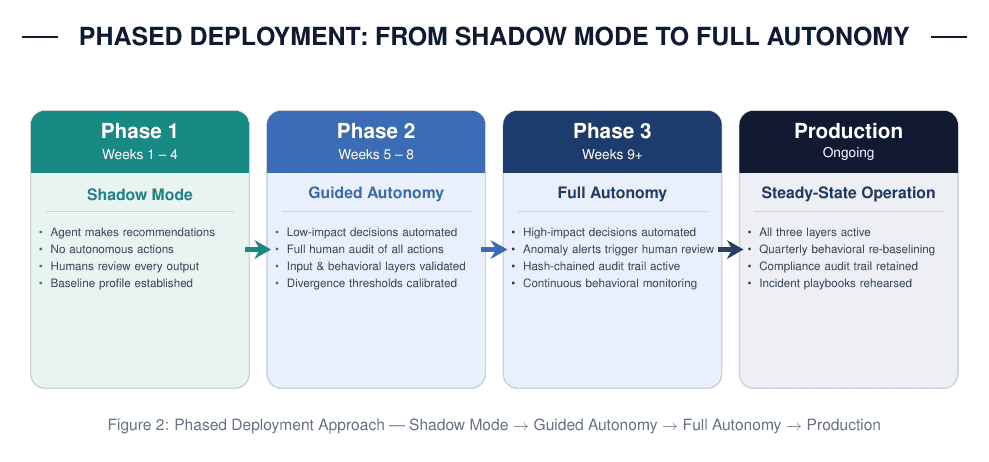
Figure 2: Phased Deployment Approach
Design for Specialization and Interpretability
Multiple specialized agents, each responsible for a specific domain and coordinated through a secure orchestration layer, are more resilient than a single general-purpose agent. When one agent fails, impact is bounded.
Optimize for interpretability as well as accuracy. In healthcare, a 94% accurate model with clear explanations proved more valuable than a 96% model with only confidence scores. The difference in accuracy fell within the margin of error, while the explanations materially reduced analyst validation time.
The Business Case and Governance Mandate
These safeguards require investment. Organizations that implement input integrity and behavioral monitoring report significantly fewer AI-related operational incidents. Hash-chained provenance reduces time-to-resolution for compliance investigations. Phased deployment reduces post-deployment rework. Specialized agent architectures help contain the impact of failures.
For Chief Data Officers, agentic AI deployment is a governance imperative as much as a technology decision. It bridges data governance and AI governance, two domains that must converge as autonomous systems become enterprise infrastructure. Governance priorities include runtime data validation, behavioral accountability, monitoring and intervention, and regulatory alignment with transparency and auditability requirements.
Getting Started: A CDO Roadmap
- Assess data governance readiness and identify data streams agents will consume.
- Define behavioral baselines by determining what “correct behavior” looks like before deployment.
- Plan for phased deployment with 8 to 12 weeks of shadow/audit phases before full autonomy.
- Invest in observability tools that monitor behavior, alert on divergence, and enable investigation.
- Establish decision logging infrastructure for post-hoc auditability.
Conclusion: From Pilot to Production
Agentic AI operates in enterprises today. The difference between safe and unsafe deployments is architectural discipline, not model sophistication.
Organizations that successfully deploy agentic AI apply enterprise architecture rigor: input validation, behavioral monitoring, decision provenance, phased rollout, and continuous observability. This is how critical infrastructure has been designed for decades.
For CDOs ready to unlock agentic AI’s productivity benefits, the question is no longer whether safe deployment is possible. It’s whether your organization will implement the governance and architecture needed to achieve it.




 Elevate Your Personal Brand